Showing posts with label Embraer. Show all posts

Friday, 1 November 2019

Embraer E195 Specs, Interior, Cockpit, and Price

01:00
Embraer E195 Specs, Interior, Cockpit, and Price – The Embraer E195 is a commercial aircraft with a capacity of 108 passengers belonging to the E-Jet family produced by Embraer, Brazil. The E195 aircraft made its first flight in December 2004 and began operations in September 2006 with the airline Flybe. This aircraft was certified by the Brazilian Aviation Authority in June 2006. Meanwhile the European Aviation Agency (EASA) type certification was received in July 2006 and the Federal Aviation Administration (FAA) certification was received in August 2007.

The E195 aircraft is the largest variant in the E-Jet family developed by Embraer. This is an extended version of the Embraer E-190 aircraft. In addition to the aircraft, other members of the E-Jet family include E170 (70 passengers), E175 (78 passengers), and E190 (98 passengers).

Embraer E195 Jetliner

Embraer E195 Specs

The Embraer E195's fuselage has a low-wing monoplane design with two podded engines mounted under conventional wings and tail. The wingtips are equipped with winglets to reduce wing vortex pull and provide increased lift and wing efficiency. Overall, the E195 aircraft has a length of 38.65 m, wingspan 28.72 m, and a height of 10.55 m.

The E195 aircraft is designed to operate day and night on domestic and international flight routes. It can carry 12,971 kg of fuel. The aircraft is equipped with Parker Hannifin's fuel system, retractable three-wheeled landing gear type, and Hamilton Sundstrand auxiliary power unit to provide the electricity needed.

Embraer E195 Engine and Performance

The Embraer E195 is powered by two General Electric turbofan engines of type CF34-10E. Each engine is capable of producing a maximum thrust of 20,000 lb (89 kN). The engine is equipped with full authority digital engine control (FADEC), wide fan angle, 4-stage low pressure turbine, 1-stage high pressure turbine, 14-stage high pressure compressor, and annual combustion. Overall, the engine CF34-10E has a length of 3.68 m, a diameter of 1.44 m and a dry weight of 1,678 kg.

The E195 aircraft has a maximum speed of Mach 0.82 (871 km / h) with a maximum flying range of 4,260 km. The aircraft can ride at a speed of 17.76 m / s. The aircraft service ceiling is 12,500 m. E195 requires 2,179 m of takeoff distance and 1,282 m of landing.

Embraer E195 Cockpit

Embraer E195 Cockpit and Avionics

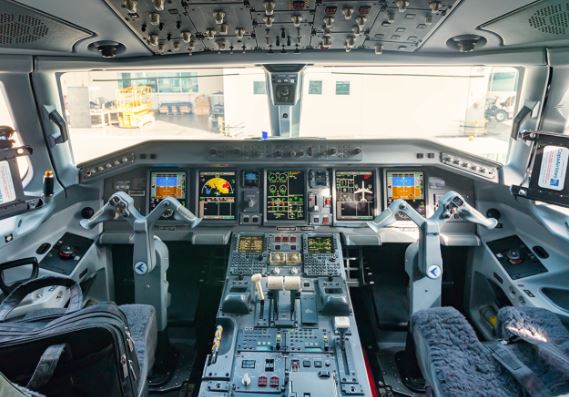
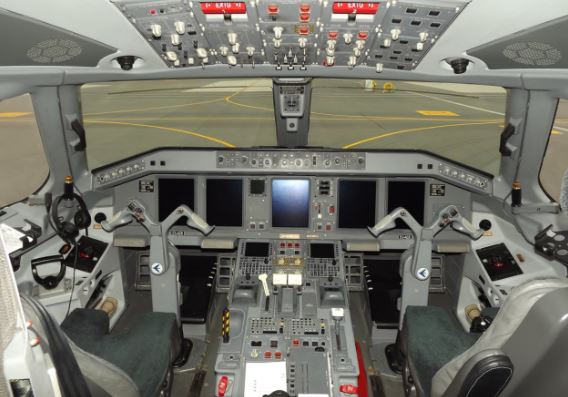
The Embraer E195 cockpit can accommodate two crew members, namely the pilot and co-pilot. The modern cockpit of the E195 is equipped with a main flight display, multifunction screen, multifunctional control display unit, Honeywell Primus EPIC electronic flight instrumentation system, and audio control panel. It also has an electronic fly-by-wire flight control system that minimizes pilot workloads by conducting autopilot missions.

Other avionics suites on the E195 aircraft include engine crew indication and warning systems, integrated electronic standby systems, cursor control devices, air data computers, navigation compasses, lights, engine panels, and ram air turbines.

Embraer E195 Interior

Embraer E195 Cabin and Interior

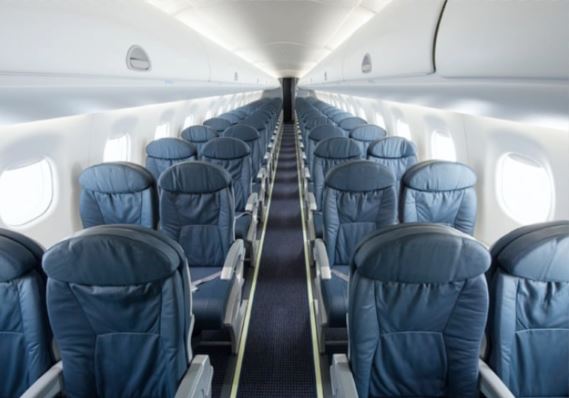
The E195 cabin has a double bubble design, offering extra space and a high level of comfort for passengers. The spacious cabin accommodates 108 to 124 passengers with a center aisle and four-parallel configuration. Unlike other conventional aircraft, luggage space is provided under the passenger seating area. Overall, the E195 aircraft cabin is 28.17 m long, 2.74 m wide, and 2 m high. The cabin baggage volume is 27.17 m3.

Embraer E195 Price and Orders

The price of the latest Embraer E195 aircraft is around US $ 53.5 Million. At present, around 150 E195 aircraft are operating in various airline services and flight routes throughout the world.

Five additional E195s were ordered by Azul Linhas in July 2010. Embraer was awarded a $ 497.5 million contract by Azul Linhas in October 2011 to supply 11 additional E195s. Air Dolomiti ordered five additional E195 jets in September 2011.

In October 2013 Aurigny Air Services signed a firm contract with Embraer for one E195 jet and was delivered in the first half of 2014. Belavia Belarusian Airlines signed a contract with Embraer for two E195 in October 2013. The first E195 delivery was carried out in the first half of 2014.

Wednesday, 30 October 2019

Embraer E190 Specs, Interior, Cockpit, and Price

01:00
Embraer E190 Specs, Interior, Cockpit, and Price – The Embraer E190 is a commercial aircraft with a capacity of 78 passengers belonging to the E-Jet family produced by Embraer, Brazil. The E190 was launched in June 1999 and made its first flight in March 2004. It received the US Federal Aviation Administration (FAA) certification in September 2005 and entered service with JetBlue in January 2006. Certification of the steep approach to the Embraer E190 was received in 2010 to operate at the Airport London City.

The construction of the E190 aircraft involved various companies as suppliers of aircraft parts. The Japanese company Kawasaki supplies wing pieces, flaps and spoilers, surface control and front and rear ends. Gamesa Spain supplies parts of the rear fuselage and vertical and horizontal tail surfaces. Radome and forward fuselage are produced by Embraer, middle fuselage are by Embraer and Latecoere, rear fuselage by Gamesa and tailcone by Hamilton Sundstrand.

Embraer E190 Jetliner

Embraer E190 Specs

The E190 fuselage has a conventional low-wing monoplane design with two podded engines mounted under the wing. The wingtips are equipped with winglets to reduce wing vortex pull and provide increased lift and wing efficiency. This aircraft has a tailplane that moves all. Overall, the E-190 aircraft has a length of 36.24 m, wingspan 28.72 m, and a height of 10.57 m.

The E190 is equipped with front and rear doors on both sides of the fuselage. This makes the aircraft have a very complete airport turnaround time with a simultaneous service mechanism. In addition, the aircraft only takes ten minutes to refuel through a single point refueling container. The aircraft can carry 13,000 kg of fuel and is equipped with the Parker Hannifin fuel system.

The landing mechanism of the E190 aircraft is equipped with a retractable three-wheel type Liebherr landing gear. Each unit is equipped with twin wheels. The aircraft requires a minimum runway length of 1,463 m for takeoff and 1,280 m for landing. The minimum base width needed for a 180 ° turn is 18.04 m.

Embraer E190 Engine and Performance

The E190 Embraer is powered by two General Electric turbofan engines of type CF34-10E which are mounted under the wing. Each engine is able to provide a maximum thrust of 20,000 lb (89 kN). The engine is equipped with full authority digital machine control (FADEC).

A fully computerized management system can optimize engine performance, thereby reducing fuel consumption and maintenance requirements. The aircraft is equipped with additional Hamilton Sundstrand power units and electrical systems.

Embraer E190 aircraft has a maximum speed of Mach 0.82 (871 km / h) with a maximum range of 4,537 km. This makes the aircraft capable of operating between city pairs such as Dallas to Bogota, Paris to Moscow, Hong Kong to Bombay and Brasilia to Santiago. Field performance allows the aircraft to operate at sensitive airport restrictions that are located in strategic places such as Santos-Dumont Airport, Florence and London City.

Embraer E190 Interior

Embraer E190 Cabin and Interior

The E190 aircraft cabin has a double bubble type, making the cabin size larger (2.53 m on the floor and 2.74 m on the shoulder level) and easier access to overhead bins. The height in the passenger cabin is 2.00 m.

The cabin can accommodate 98 passengers with a four-parallel configuration. The cabin has an interior double-bubble seats design that offers spacious aisles and seating. The interior of the E190 cabin was designed by C&D Aerospace.

Embraer E190 Cockpit

Embraer E190 Cockpit and Avionics

The Embraer E190 aircraft has an all-digital cockpit. The cockpit is integrated with a modular and lightweight avionics suite. The avionics suite includes a Honeywell Primus Epic electronic flight system and an information system (EFIS) with five LCDs to display all flight data.

The E190 aircraft is equipped with fly-by-wire flight controls, thus reducing the pilot's work in controlling the aircraft. Flight control covers all primary controls, with the exception of ailerons.

Embraer E190 Price and Orders

The price of the latest Embraer E190 aircraft is around US $ 50.6 Million. At present, around 500 E190 aircraft have been operating with various airlines from all over the world including Air Canada, British Airways CityFlyer, Copa Airlines of Panama, TAME of Ecuador, a subsidiary of Air France Regional, Aerorepublica, HNA Group of China, US Airways, Lufthansa, Virgin Blue, KLM Cityhopper, NAS Air from Saudi Arabia, and TACA from El Salvador.

CDB Leasing Company ordered 30 Embraer E190 jets in 2011. The first aircraft were delivered in August 2011. TRIP Linhas Aereas awarded a $ 172 million contract to Embraer on March 1, 2011 to supply four Embraer E190 jets configured to a single 110-class seat.

Kazakhstan-based Air Astana ordered two Embraer E190 jets in June 2011 with an option for the other two. Kenya Airways ordered ten aircraft in August 2011 with the option to purchase 16 additional aircraft.

Azerbaijan Airlines (AZAL) received the first shipment of four Embraer E190 in July 2013. Venezuelan Airlines Consorcio Venezolano de Industrias Aeronáuticas y Servicios Aéreos (Conviasa) signed a contract for seven Embraer E190 jets, using the option of the original order released in July 2012 with which provided six firm orders and 14 options in June 2013.

Monday, 28 October 2019

Embraer E175 Specs, Interior, Cockpit, and Price

01:00
Embraer E175 Specs, Interior, Cockpit, and Price – The Embraer E175 is a commercial aircraft with a capacity of 78 passengers belonging to the E-Jet family produced by Embraer, Brazil. The E175 made its inaugural flight in June 2003 and has since obtained type certification for aircraft from several aviation authorities in Brazil, Europe and the US The aircraft entered service with Air Canada in July 2005 and the Federal Aviation Administration (FAA) Certification was received in September 2006.

Embraer currently produces E175 aircraft in three versions, namely standard (STD), long range (LR) and advanced range (AR). The AR version was introduced in 2007. It offers greater coverage and load capacity, which is generated from structural reinforcements. Embraer has launched a program to improve E-Jet aircraft, including E175. To reduce fuel combustion by 5%, the aircraft is being added with new wingtips, system improvements, and aerodynamics.

Embraer E175 Jetliner

Embraer E175 Specs

The E175 fuselage features a low-wing monoplane design with a conventional tail shape. Overall, the Embraer E175 has a length of 31.68 m, a wingspan of 26 m, and a height of 9.86 m. The maximum load capacity ranges from 10,080 kg to 10,360 kg depending on the aircraft version.

The E175 aircraft is equipped with integrated cost-effective design features with features to maximize passenger comfort. Two doors are provided at the front and rear for passengers. A series of similar doors are provided separately at the front and rear for service personnel and cargo.

The landing mechanism of the E175 aircraft is equipped with a tricycle type, two wheel type Liebherr landing gear. The aircraft requires a minimum runway length of 1,261 m for takeoff and 1,259 m for landing. The minimum base width needed for a 180 ° turn is 18.04 m.

Embraer E175 Engine and Performance

The Embraer E175 is powered by two General Electric type CF34-8E turbofan engines controlled by FADEC mounted under the wing. Each engine is able to provide a maximum thrust of 14,200 lb. The engine has an engine dry weight of 2,627 lb and a thrust-to-weight ratio of 5.41. The machine is fully interchangeable and has a maximum diameter of 136 cm. Engine noise complies with stage III and IV standards.

The maximum speed of the E175 aircraft is 0.82 mach (871 km/ h). The aircraft takes 18 minutes to climb and can fly with maximum operating speed. The E175 can fly to a maximum height of 41,000 ft and a maximum range of 3,151 km for the STD version, 3,521 km for the LR version, and 4,074 km for the AR version.

Embraer E175 Interior

Embraer E175 Cabin and Interior

The E175 can accommodate 78 to 88 passengers, depending on the version chosen by the operator. The cabin is spacious, 21.2 m long, 2.74 m wide and 2 m high. The four-parallel seating configuration and interior design of the double-bubble chair offer spacious aisles and seating. Thus allowing passengers to board the plane more easily.

The E175 aircraft cabin with 78 seats configuration has a arrangement of 19 double seats on the left and 20 double seats on the right. This arrangement can be optionally modified to double the first class seat on the right and the first class seat on the left. The cabin also accommodates one observer and two flight attendants. Additional seats for the second observer can be installed optionally.

The E175 aircraft is equipped with two cargo compartments under the floor. Compartments are located in the front and rear wing. The front compartment is bigger, with a volume of 9.92 m3 and a loading capacity of 1,500 kg. The rear compartment is smaller, with a cargo volume of 7.2 m3 and a loading capacity of 1,150 kg. Door nets are installed at each cargo door, while vertical nets can also be optionally installed.

Embraer E175 Cockpit

Embraer E175 Cockpit and Avionics

The E175 cockpit has two seats for pilots and co-pilots, with controls and systems that are easily accessible. It's acoustic and thermally insulated. The hand microphone is mounted on the left front door. The circuit breaker is located directly below it. The steering handle is conveniently located next to the hand microphone.

The cockpit is equipped with a series of digital avionics systems, including multifunctional LCDs, guide panels, electronic instrument systems (EIS) and primary flight displays (PFD).

Embraer E175 Price and Orders

The price of the latest Embraer E175 aircraft is around US $ 46 Million. At present, E175 has operated with 12 well-known passenger airlines, including Air Canada, Oman Air, Republic Airlines, Royal Jordanian Airlines, Northwest Airlines, Jet Airways, and others. More than 150 E175 are in operational services.

United Airlines placed a contract for 30 E175 jets in April 2013 and the first aircraft were delivered in April 2014. Mesa Airlines operates new aircraft under the United Express brand. United Airlines booked $ 1.1 billion at Farnborough Airshow in July 2018 for 25 E175 jets.

American Airlines booked $ 2.5 billion for 60 E175 aircraft plus options for 90 more in December 2013. The first aircraft was delivered in February 2015. The airline ordered $ 705 million for 15 E175 aircraft, increasing the total to 104. Shipping scheduled to begin in 2020.

In July 2014, Trans States Holdings ordered 50 E175-E2 jets. The $ 2.4 billion contract also includes an option for an additional 50 units. Deliveries are scheduled to begin in June 2020.

SkyWest placed a $ 301 million order for seven E175 jets in November 2014, as part of a previous order from the company for 100 E-Jets (40 companies and 60 reconfirmables) in 2013. This contract was followed by a new $ 422 million contract awarded in January 2018 for nine E175 jets, increasing the number of orders to 158. Deliveries begin in 2019.

Saturday, 26 October 2019

Embraer E170 Specs, Interior, Cockpit, and Price

01:00
Embraer E170 Specs, Interior, Cockpit, and Price – The Embraer E170 is a commercial aircraft with a capacity of 70 passengers belonging to the E-Jet family produced by Embraer, Brazil. The E170 was launched in June 1999 and made its maiden flight in February 2002. It obtained Brazilian, US and European certification in February 2004 and entered service with the Polish LOT airline in March 2004.

The E170 is the first member in the E-Jet family developed by Embraer. In addition to the aircraft, other members of the E-Jet family include E175 (78 passengers), E190 (98 passengers), and E-195 (108 passengers). Embraer has launched a program to improve E-Jet aircraft, including the E170. To reduce fuel combustion by 5%, the aircraft is being added with new wingtips, system improvements, and aerodynamics.

Embraer E170 Jetliner

Embraer E170 Specs

The E170's fuselage has a low-wing monoplane design with a podded engine mounted under the wing. The wingtips are equipped with winglets to reduce the pull of the vortex end and provide increased lift and increase wing efficiency. Overall, the Embraer E170 has a length of 29.90 m, a wingspan of 26.00 m, and a height of 9.85 m.

The E170 aircraft's fuel tanks are located on both wings. The tank has a maximum capacity of 9,470 kg and is equipped with the Parker Hannifin fuel system. The remote variant ERJ-170 is equipped with an additional fuel tank mounted in the trunk compartment.

The fuselage has front and rear doors on both sides, allowing passengers to get on and off with simultaneous service. This aircraft has a one-point refuel for ten minutes and under-wing engines can be serviced from the ground without a stand.

The landing mechanism of the E170 aircraft is equipped with a retractable three-wheel type Liebherr landing gear. Each unit is equipped with twin wheels. For takeoff, the aircraft requires a runway with a minimum length of 1,261 m. The minimum base width needed for a 180 ° turn is 18.04 m.

Embraer E170 Engine and Performance

The E170 is powered by two General Electric turbofan engines of type CF34-8E mounted under the wing. Each engine is capable to provide a maximum thrust of 14,200 lb. The engine is controlled by a full authority digital engine control (FADEC). A fully computerized flight management system that optimizes engine performance in each flight phase, thereby reducing fuel consumption and maintenance costs.

The maximum speed of the E170 aircraft is 0.82 mach (871 km/ h). The E170 can fly to a maximum height of 41,000 ft and a maximum range of 3,982 km at long distance cruising speeds and with full passenger seating. The aircraft is able to operate between the city pairs of Dallas to Halifax, Paris to Moscow, Hong Kong to New Delhi, and Brasilia to Caracas.

Embraer E170 Cockpit

Embraer E170 Cockpit and Avionics

The E170 aircraft is equipped with an all-digital cockpit that is integrated with a lightweight modular-architecture avionics suite. The Avionics Suite includes Honeywell Primus Epic Electronic Aviation and Information Systems (EFIS) with five LCDs to display all flight data.

Flight control of E170 is a computer control with fly-by-wire technology. All aircraft flight mechanisms are controlled with this technology, except for ailerons.

Embraer E170 Interior

Embraer E170 Cabin and Interior

The E170 aircraft cabin can accommodate 70 passengers. The cabin has a four-parallel configuration with a double-double seat arrangement, thus providing wider aisle and seating access with 81 cm seat pitch. The interior of the E170 aircraft was designed by C&D Aerospace.

Embraer E170 Price and Orders

The price of the latest Embraer E170 aircraft is around US $ 42 Million. At present, 193 Embraer E170s have been ordered and are operating with various airlines throughout the world, including Alitalia, British Airways City Flyer, Switzerland, GE Capital Aviation Services (GECAS), US Airways, LOT Airlines, PB Air, Air Caraibes, Republic Airways Holdings, Finnair, TAME of Ecuador, Saudi Arabian Airlines, Egyptair, Virgin Blue, Air France Regiona, and Virgin Nigeria.

Wednesday, 7 August 2019

Embraer ERJ-145 Specs, Interior, Cockpit, and Price

01:00
Embraer ERJ-145 Specs, Interior, Cockpit, and Price – ERJ-145 is a twin-engine regional jet that can accommodate 50 passengers manufactured by Embraer Aerospace, Brazil. This aircraft is the widest variant in the Embraer Regional Jet (ERJ) family. The inaugural flight ERJ-145 was carried out in August 1995. The aircraft was certified by the Department of Aerospace Science and Technology in 1996. The aircraft first operated in December 1996 and operates with 27 airlines around the world. In May 2008, the ERJ family received Russian certification, allowing operations in Russia and the Commonwealth of Independent Countries.

Embraer ERJ-145

Embraer ERJ-145 Specs

The ERJ-145 aircraft has a circular cross-section fuselage, two engines mounted behind, a low swept wing mounted, and a T-tailplane. Radom's nose was supplied by Norton and the manufacture of the back and center of the fuselage was subcontracted to Sonaca from Belgium.

The wings supplied by Gamesa Spain have a two spar design with a third spar to support the landing gear. The main edge of the wing is made of aluminum. The ERJ-145XR variant features wings with winglets to increase lift and increase wing efficiency at cruising speeds by reducing tip vortex pulls.

ENAER from Chile designs and supplies fins and tails. T-tail is made of an aluminum box construction with the leading edge of aluminum on the tailplane. The main advantage of fins is composite construction.

The ERJ-145 aircraft is equipped with a tricycle type landing gear that is pulled to EDE. Liebherr was subcontracted for the development and supply of nose landing equipment. Each twin Goodrich wheel unit is equipped with carbon brakes. The main units pull in to the wing landing gear and fuselage fairing. The nose unit pulls forward. The aircraft is equipped with the Hydro-Aire brake-by-wire control system. Nosewheel can be controlled and the minimum rotation circle is 29.22 m.

The ERJ-145 has a range of 2,963 km, while the remote variant of the ERJ-145LR has a range of 3,037km and a remote variant of the extra ERJ-145XR has a range of 3,704 km.

Embraer ERJ-145 Engine

The ERJ-145 aircraft is powered by two Rolls-Royce AE 3007A engines with a rating of 31.3kN. The engine is mounted on a pole on the back of the fuselage. Machine posts are provided by Sonaca from Belgium. The machine is equipped with a full authority digital engine control system. International Nacelle Systems develops and supplies engine nacelles and optional clamshell thrusters. Engine air intake is equipped with an air anti-icing system.

The long-distance ERJ-145LR aircraft is equipped with a Rolls-Royce AE 3007A1 engine that provides 15% more power. The engine is rated at 33.1kN to provide better climbing characteristics and improve cruise performance in high ambient temperatures.

The extra long ERJ-145XR aircraft is equipped with a Rolls-Royce AE 3007A1E engine. The high-performance engine provides lower specific fuel consumption (SFC) and better performance in hot and high conditions. The engine also produces a higher altitude for the condition of one engine that cannot be operated.

To support engine performance, the aircraft is equipped with the Smiths electric power system and Parker Hannifin's fuel management system. The integral wing tank has a capacity of 4,173 kg of fuel.

The Embraer ERJ-145 can fly at a maximum speed of 833km / hour. The jet service range and ceiling are 3.704 km and 11.275m. The service ceiling with one engine that cannot be operated is 6,100m. The takeoffs and landings are 2.430m and 1.440m respectively. This aircraft weighs around 12,934kg and the maximum takeoff weight is 12,934kg.

Embraer ERJ-145 cockpit

Embraer ERJ-145 Cockpit and Avionics

The cockpit of Embraer ERJ-145 aircraft can accommodate two pilots, an aviation observer and a cabin crew member. This instrumentation includes the appearance of the head of Flight Dynamics which provides the capability of landing a CAT III aircraft. Five electronic flights and information display systems, each measuring 20.3cm × 18cm (8in × 7in) including two multifunction screens, two main flight screens and one onboard engine condition monitoring system (IECMS).

The Embraer ERJ-145 aircraft is equipped with the Honeywell Primus 1000 avionics suite with dual digital air data computers, dual attitude reference systems (AHRS), terrain collision avoidance systems (TCAS) and ground proximity warning systems (GPWS). An optional flight management system and global positioning system can be installed. This aircraft has Primus 1000 color weather radar and Primus II dual radio communication package.

Early warning and air control aircraft EMB-145AEW & C is a derivative of the ERJ-145 and equipped with an air radar that appears on the side of Ericsson Erieye. This is in service with the Brazilian Air Force and the Greek Air Force. Remote sensing EMB-145RS equipped with surveillance mission equipment, in service with the Brazilian Air Force for the Brazilian Government's Amazon SIVAM surveillance program.

Embraer ERJ-145 interior

Embraer ERJ-145 Cabin and Interior

The ERJ-145 main cabin can accommodate 50 passengers in a parallel three-seat configuration. Cabin and luggage compartments are designed by aircraft interior design companies, C & D Interiors based in the United States.

The passenger door on the front side of the port is equipped with airstairs. Cabin and luggage compartments are air-conditioned and pressurized. The aircraft has a Hamilton Sundstrand air conditioning system and a Liebherr Aerospace pressurization system. The oxygen system is supplied by EROS.

Embraer ERJ-145 Price and Orders

The latest Embraer ERJ-145 price is around US $ 59 Million. Passaredo Linhas Aereas received the first ERJ-145 regional jet from Embraer in May 2009 as part of a contract signed in November 2008.

In September 2009, Embraer sent ERJ-145 jets to the Brazilian Federal Police Department, while Serviços Executivos Aéreos de Angola (SEAA) purchased an ERJ 145 jet from Embraer in October 2009.

Tianjin Airlines received the last ERJ-145 from Harbin Embraer Aircraft in May 2011.

Monday, 5 August 2019

Embraer ERJ-135 Specs, Interior, Cockpit, and Price

01:00
Embraer ERJ-135 Specs, Interior, Cockpit, and Price – The ERJ-135 is a twin-engine regional jet that can accommodate 37 passengers and a member of the Embraer Regional Jet (ERJ) family manufactured by Embraer Aerospace, Brazil. The aircraft was launched in 1997 and the first flight was carried out in July 1998. Certification from the Centro Tecnico Aerospacial (CTA) of Brazil, the US Federal Aviation Administration (FAA) and the European Joint Aviation Authority (JAA) was awarded in 1999.

Final assembly, system integration, and testing of the ERJ-135 aircraft are carried out at Embraer's aerospace manufacturing facility in Sao Paulo. Making several aircraft parts carried out by subcontractors and subassemblies was transported to Sao Paulo for assembly. Norton supplies the nose radome, Sonaca from Belgium in the back and center of the fuselage, Gamesa from Spain wing and ENAER from Chile fin and tail.

Embraer ERJ-135

Embraer ERJ-135 Specs

The Embraer ERJ-135 has a cross-section circular fuselage, a high-mounted rear by-pass engine, low-swept wings, and a T-tail aircraft. This aircraft has 98% similarity in parts and systems, as well as crew rankings, with other members of the ERJ family.

The wing consists of two spar wing designs with a third spar to support the landing gear. The front edge of the wing is made of aluminum. T-tail is made of an aluminum box construction with the leading edge of aluminum on the tailplane. The leading edge of the fin is composite construction.

The ERJ-135 aircraft is equipped with EDE-type three-wheeled landing gear. Liebher produces a nose landing gear that is pulled forward. The main units pull in to the wing landing gear and fuselage fairing. This unit is equipped with Goodrich wheels and carbon brakes with a Hydro-Aire brake-by-wire control system.

Embraer ERJ-135 Engine

The ERJ-135 aircraft is powered by two Rolls-Royce AE 3007A engines with a rating of 31.3kN. The engine was installed behind the mast, supplied by Sonaca from Belgium. The Nacelle International system supplies engine nacelles and optional clamshell push inverters. The engine is equipped with full authority digital engine control and the engine air intakes are equipped with an engine bleed air anti-icing system.

The long range variant of the ERJ-135LR is equipped with a Rolls-Royce AE 3007A1 engine, which provides 15% more power. This machine is rated 33.1kN to provide better climbing characteristics and improve roaming performance in high ambient temperatures.

The aircraft is equipped with Parker Hannifin fuel management system. The integral wing tank has a capacity of 4,173 kg of fuel on the ERJ-135ER and 5,187kg on the ERJ-135LR. The aircraft is equipped with the Smiths electric power system and an additional APIC APS-500 power unit equipped with 18.6kW of power.

Embraer ERJ-135 can fly with a maximum speed of 955km / hour. The cruising speed is 833km / hour. The range and ceiling of aircraft services are 3,200 m and 11,278 m respectively. The aircraft takeoff rate is 1,700 m while the landing is 1,360 m. This aircraft weighs around 11,200 kg and the maximum takeoff weight is 19,000 kg.

Embraer ERJ-135 cockpit

Embraer ERJ-135 Cockpit and Avionics

The ERJ-135 aircraft cockpit is equipped with a Honeywell Primus 1000 glass digital avionics set with dual digital air data systems, dual attitude, post and reference systems (AHRS), traffic warning and avoidance (TCAS) systems and location proximity warning systems (GPWS) .

This instrumentation includes the appearance of the head of Flight Dynamics which provides the capability of landing a CAT III aircraft. Five electronic flights and information display systems, each measuring 20.3cm × 18cm (8in × 7in), including two multifunction screens, two main flight screens and one onboard engine condition monitoring system (IECMS).

An optional flight management system and global positioning system can be installed. This aircraft has Primus 1000 color weather radar and Primus II dual radio communication package.

Embraer ERJ-135 interior

Embraer ERJ-135 Cabin and Interior

The ERJ-135 main cabin was designed by aircraft interior design company, C & D Interior, United States. Cabin provides three-parallel seating for up to 37 passengers. The inside of the aircraft can be easily configured in different settings according to the specific needs of the customer.

The passenger door is located on the front side of the cabin. The cabin and luggage compartment is air-conditioned and is stressed by Hamilton Sundstrand's AC system and Liebherr's Aerospace pressurization system. The oxygen system is supplied by EROS.

Embraer ERJ-135 Price and Orders

The latest Embraer ERJ-135 price is around US $ 16.5 Million. The ERJ-135 began operations with Continental Express and American Eagle in July 1999. Around 132 ERJ-135 regional jets were ordered for operators including British Midland, Chautauqua Airlines, City Airlines, Flandre Air, Jetmagic, Luxair, Proteus and AirLink South Africa.

In November 2007, the contract was placed for two aircraft for the Royal Thai Army and two for the Royal Thai Navy. The aircraft will be used for transportation missions and medical evaluations.

In October 2009, two ERJ-135 and one ERJ-145 regional jet were sent to Servicos Executivos Aereos de Angola (SEAA), a scheduled start-up airline based in Africa. The Jet ERJ-135 was originally used on domestic routes including Luanda, Cabinda, Ondjiva and Saurimo. In January 2010, ECC Leasing, a subsidiary of Embraer, leased four ERJ-135 jets to AirLink South Africa.

Monday, 24 June 2019

Embraer Lineage 1000 Specs, Interior, Cockpit, and Price

01:00
Embraer Lineage 1000 Specs, Interior, Cockpit, and Price – Business Jet Embraer Lineage 1000 is a large and long distance business jet developed by Embraer, Brazil. This aircraft was announced in 2006 and FAA certification was awarded in 2007 and the aircraft received certification from the Brazilian National Civil Aviation Agency and the European Aviation Safety Certification Agency (EASA) in December 2008. The aircraft entered service in May 2009. The aircraft model also won a design award IDEA / Brazil in 2008.

This aircraft has a maximum operating speed of Mach 0.82 and an operating ceiling of 12,497 m (41,000 feet). The range of eight passengers is 7,778 km, allowing non-stop flights between London and New York, Europe and the Middle East or New York and Brazil. Embraer Lineage 1000 performance and its low noise profile provide direct access to limited airports such as London City (England), Teterboro (New York) and Aspen (Colorado).

Embraer Lineage 1000

Embraer Lineage 1000 Specs

Construction of parts of the Lineage 1000 business jet body was carried out by Embraer, Gamesa and Latacoere. Kawasaki is a manufacturer of several wing parts. PATS Aircraft Completions is a division of DeCrane Aerospace, to equip the cabin with customer specifications.

Embraer Lineage 1000 has a low wing design with winglets and fly-by-wire controls. This is a high strength, low weight, composite, non-structural metal construction such as cabin floor panels and fuselage fairing.

The Liebherr landing gear is equipped with a carbon braking system and two wheels in each unit. Parker Hannifin is responsible for manufacturing hydraulic systems and fuel systems.

Embraer Lineage 1000 Engine

Embraer Lineage 1000 is powered by two General Electric GE CF34-10E7-B podded engines mounted under the wing, providing thrust of 89.0 kN. The engine is equipped with full authority digital engine control (FADEC) and thrust reversing. The Hamilton Sundstrand (APU) auxiliary unit is installed in the tailcone.

Embraer Lineage 1000 interior

Embraer Lineage 1000 Cabin and Interior

One of the most prominent features of the Embraer Lineage 1000 is its innovative and luxurious cabin layout, designed by Priestman Goode, based in London, England.

The total volume of the cabin is 4,085ft³ (115.7m³), with a height of 6ft 7in (2.0m). The interior is arranged in five different privacy zones to relax, conference, eat or relax and can carry up to 19 passengers.

The first zone is arranged with three club chairs, a folding table and a bar. Zone 2 has couch chairs and two single club chairs with folding tables.

Zones 3 and 4 accommodate lounge and offices with long cots, single club chairs and credenza with 32-inch LCD screen workstations. Passengers have access to the internet and Wi-Fi. Zone 5 is equipped as a double bedroom with a wardrobe, credenza, and shower cubicle.

The rear luggage area is stressed and can be accessed during flight. The total luggage capacity is 471ft³ (13.3m³).

Embraer Lineage 1000 cockpit

Embraer Lineage 1000 Cockpit and Avionics

Cockpit Embraer Lineage 1000 is equipped with the Honeywell Primus Epic electronic flight information system and the avionics device is very intuitive, simplifies procedures, improves safety, and allows pilots to concentrate on successful flight completion. Primus Epic avionics suite provides five multifunctional liquid crystal display screens. The finger-on-touchpad cursor control allows the pilot to direct and ask about avionic function.

Computerized flight flight manuals and class II electronic flight bags make paperless cockpits, which further reduces the pilot's workload. The avionics system includes the Thales integrated electronic standby system.

The aircraft is equipped with Honeywell Primus color weather radar, dual distance measuring equipment (DME), global positioning system and automatic direction finder, VHF (VOR / LOC) omnidirectional radio range tracker, traffic collision avoidance system (TCAS) and landing system microwave (MLS).

This aircraft is the first civilian jet to combine the Smart Probe which includes a series of four computerized sensors that provide more precise measurements of indications of air speed, attitude and trim.

In October 2008, Embraer selected the Elbit Systems / Kollsman Enhanced Vision (EVS II) and Rockwell Collins HGS-5600E Systems as head-up guidance systems as optional equipment for the Embraer Lineage 1000. The EVS II certification is expected in 2010.

Embraer Lineage 1000 Price and Orders

The price of the latest Embraer Lineage 1000 is US $ 53 Million.

Saturday, 22 June 2019

Embraer Legacy 650 Specs, Interior, Cockpit, and Price

20:00
Embraer Legacy 650 Specs, Interior, Cockpit, and Price – Embraer Legacy 650 is a large business jet developed by Embraer. After completing its inaugural flight in September 2009, the aircraft began operating in late 2010. The aircraft received type certifications from the National Civil Aviation Agency (ANAC), Brazil and the European Aviation Safety Agency (EASA) in October 2010. ANAC also certified Embraer Legacy 650 for operations HALTO (High Landing and Takeoff) in August 2012. In addition, the aircraft received a type certification from the US Federal Aviation Administration (FAA) in February 2011.

In June 2012, Embraer reached a joint venture agreement with the Aviation Industry Corporation of China (AVIC) to build a production line to build an Embraer Legacy 650 aircraft in China. A joint venture, named Harbin Embraer Aircraft Industry, and has launched the first aircraft from the production line at the end of 2013.

Embraer Legacy 650

Embraer Legacy 650 Specs

Embraer Legacy 650 is a longer Legacy 600 version. The range is 500nm higher than Legacy 600. The aircraft also provides a higher take-off and climbing height than the Legacy 600 aircraft. The landing distance of the aircraft that is not in fact is 5.741 feet (1,750 m) and takeoff distance is 5,741 feet (1,750 m). The operating height is 41,000 feet (12,497 m).

The aircraft has a 38.5in compound sweeper propeller and is equipped with new propellers and core propellers. Has a length of 26.33 m, height of 6.76 m, and wingspan of 21.17 m.

The takeoff weight of the Embraer Legacy 650 is 53,572lb (24,300 kg), while the landing weight is 44,092lb (20,000 kg). This aircraft has zero fuel weight of 36,155lb (16,400 kg).

Embraer Legacy 650 Engine

Embraer Legacy 650 is powered by the AE3007A2 turbofan engine manufactured by Rolls-Royce. Both engines produce about 9,020 lb of maximum thrust each. The engine emits about 22% less CO2. It also has a digital engine control system (FADEC) full authority. This aircraft has a range of 3,900nm (7,223 km) and cruising speed of Mach 0.80. The plane's service ceiling is 12,497 m.

Embraer Legacy 650 interior

Embraer Legacy 650 Cabin and Interior

Embraer Legacy 650 has three spacious cabin zones, which provide seating for up to 14 people. The Honeywell Ovation Select cabin management system is installed in the enhanced Embraer Legacy 650, which was introduced as a special edition in 2012.

The aircraft has a total of 22 windows, which provide abundant natural light in the cabin. This cabin has full anchored seats, as well as a spacious and fully equipped kitchen, and the largest toilet in its class. Optional forwarding toilets can also be included.

The cabin has a luggage compartment with 240ft3 (6.8m3) of space and an internal storage space of around 46ft3 (1.3m3).

Galley is equipped with a touch screen monitor for the main control of the cabin system, refrigerator or wine cooler, coffee maker or Espresso machine, microwave, and three electrical outlets.

The enhanced version of the cabin management system offers passenger control on all seats, iPod / iPhone dock stations, Blu-ray players, radios, 3D maps and wireless remote controls. The interior is also enhanced in an enhanced version, with 12 choices of new veneers, six choices of stone floors, protective vinyl carpets, and satin linings.

Embraer Legacy 650 cockpit

Embraer Legacy 650 Cockpit and Avionics

Embraer Legacy 650 has a spacious flight deck equipped with Honeywell Primus Elite avionics suite. This aircraft has a large cockpit with a spacious flight deck equipped with Honeywell Primus Elite avionics suite.

Flight flight decks include LCD screens with Cursor Control Devices (CCDs), new airspace operating standards, and chart and map capabilities. The avionics system is also equipped with an integrated standby instrument system, electronic flight bag, and central maintenance computer, paired VNAV, 1000 data loader with SD card and USB port, RNP 0.3, and XM weather capability. In addition, the avionics system includes dual inertia reference systems, dual FMS / GPS, data link recorders, and so on.

The flight deck in the 2012 enhanced version of the Embraer Legacy 650 is equipped with the Honeywell SmartRunwayTM and SmartLandingTM systems, which enhance situational awareness of flight crews.

Embraer Legacy 650 Price and Orders

The price of the latest Embraer Embraer Legacy 650 is US $ 32 Million. Aircraft Asset Management (AAM) ordered two Embraer Legacy 650 aircraft in October 2009. The first Embraer Legacy 650 aircraft was sent to Amsair Aircraft in November 2010. The first Embraer Legacy 650 aircraft was sent to Amsair Aircraft in November 2010.

Minsheng Financial Leasing Company (MSFL), based in China, ordered 13 Embraer Legacy 650 aircraft in October 2011. The first aircraft was delivered in March 2012. Another Embraer Legacy 650 was sent to MSFL in November 2012, which marked the 200th Legacy 600 / 650 family aircraft shipments for Embraer. Embraer sent an Embraer Legacy 650 aircraft to the Aviation FAL in Saudi Arabia in May 2012.

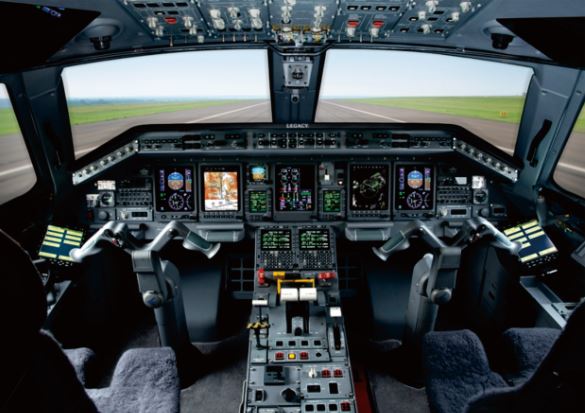
Friday, 21 June 2019

Embraer Legacy 600 Specs, Interior, Cockpit, and Price

20:00
Embraer Legacy 600 Specs, Interior, Cockpit, and Price – Embraer Legacy 600 is a super medium aircraft developed by Embraer. The aircraft began operations in April 2002. It was first launched at the Farnborough Airshow in 2000. The first flight of the aircraft was completed in March 2001. The aircraft is currently operated in more than 24 countries around the world. It is available in two versions, including the Legacy Executive and Legacy Shuttle.

Embraer reached an agreement with the Aviation Industry Corporation of China (AVIC) in June 2012, to build a production line to build an Embraer Legacy 600 aircraft in China. Shipping of the Embraer Legacy 600 aircraft is expected to begin at the end of 2013.

Embraer Legacy 600

Embraer Legacy 600 Specs

The Embraer Legacy 600 jet business combines most of the design features of the Embraer ERJ 145 and 135 families. This aircraft has an additional range and an additional fuel tank. It has wingtips to improve aerodynamic performance. The dimensions of the aircraft include lengths of 26.33 m, height of 6.76 m and wingspan of 21.17 m.

Embraer Legacy 600 Engine

Embraer Legacy 600 is powered by two AE3007A1E turbofan engines manufactured by Rolls-Royce. The machine produces a maximum thrust of 7.953lb each. This aircraft has a dual engine control system (FADEC) dual channel authority.

This aircraft offers a range of 3,400nm (6,297km). It has a high speed cruise at Mach 0.80. The plane's service ceiling is 12,500 m. The landing distance of the aircraft that is not in fact is 2,685 feet (818 m) and the takeoff distance is 5,614 feet (1,711 m). The aircraft operating height is 41,000 feet (12,497 m).

Embraer Legacy 600 interior

Embraer Legacy 600 Cabin and Interior

Embraer Legacy 600 has three spacious cabin zones to accommodate up to 13 people. This cabin has a luggage compartment with a space of 240 feet³ (6.8 m³). It also has an internal storage space of around 46ft³ (1.3m³). This aircraft has a total of 22 windows with an area of ​​around 2.65 m² providing abundant natural light.

This cabin has full anchored chairs, a spacious and fully equipped kitchen, and a large toilet. Offers some interior configuration and low cabin noise. Touch screen monitors are provided in the cabin for main control of the cab system, coffee maker or Espresso machine, microwave oven, and three electrical outlets. The cabin is also equipped with a fridge and wine cooler.

The aircraft cabin is equipped with sophisticated entertainment facilities, such as the Rockwell Collins Airshow 410, a 17-in widescreen LCD monitor with DVD players and high-speed data with the Inmarsat Swift 64128 kbps wireless network.

Embraer Legacy 600 cockpit

Embraer Legacy 600 Cockpit and Avionics

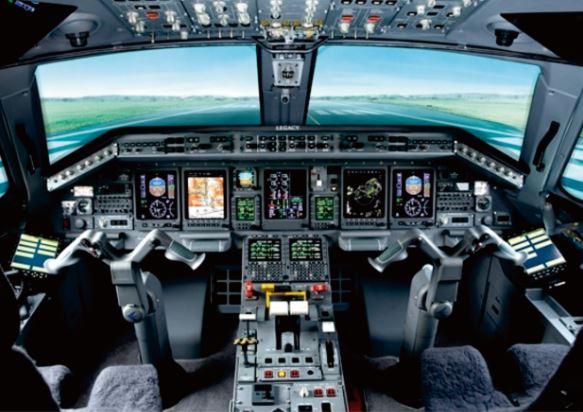
Embraer Legacy 600 has a large cockpit with a large flight deck. The flight deck is equipped with Honeywell Primus Elite avionics suite. It is equipped with an LCD screen with a cursor control device (CCD), a new standard airspace operation, graphics and map capabilities.

It is also equipped with an integrated standby instrument system, electronic flight bag and central maintenance computer, paired vertical navigation (VNAV), 1000 data loader with SD card and USB port, RNP 0.3 and XM weather capabilities.

Avionics also includes dual inertia reference systems, dual FMS / GPS, SmartLanding and SmartRunway, WAAS / LPV, CPDLC 1 / A FANS and data link recorders.

The electrical system on the flight deck includes four primary DC generators, one additional 12kVA power unit generator and two logic controllers. The aircraft has carbon brakes, ice detection and prevention systems and temperature monitoring on the cockpit screen.

Embraer Legacy 600 Price and Orders

The price of the latest Embraer Embraer Legacy 600 is US $ 26 Million. The first Embraer Legacy 600 aircraft was delivered in April 2002. ABS Jets, a carrier from the Czech Republic, was one of the initial aircraft customers, which received its first Embraer Legacy 600 aircraft in July 2004. ABS Jets bought another Embraer Legacy 600 on the month November 2005

The third Embraer Legacy 600 aircraft was sent to Titan Aviation in October 2009. United Aviation ordered a plane in July 2006. Sonangol International Holding, a company based in China, ordered two Embraer Legacy 600 aircraft in August 2007.

London Executive Aviation (LEA) received the Embraer Legacy 600 from Embraer in February 2010. Minsheng Financial Leasing ordered 13 Embraer Legacy 600 aircraft in October 2011. Three aircraft were delivered in November 2012.

Thursday, 20 June 2019

Embraer Legacy 500 Specs, Interior, Cockpit, and Price

20:00
Embraer Legacy 500 Specs, Interior, Cockpit, and Price – Embraer Legacy 500 is a medium-sized business jet developed by Embraer, a Brazilian aircraft manufacturer. The aircraft engine test was completed in January 2012 and the inaugural flight was completed in November 2012. The first prototype of the aircraft was launched in December 2011. The second and third prototypes made the first flights respectively in February and March 2013.

The final assembly line of the Embraer Legacy 500 business jet is located at the São José dos Campos facility in Embraer in Brazil. Three aircraft prototypes were built in March 2013.

Embraer Legacy 500 aircraft was given type certification by the Brazilian Civil Aviation Agency in August 2014, with Federal Aviation Administration (FAA) certification following in October 2014. European Aviation Safety Agency (EASA) certification for aircraft was given in Cologne, Germany, in December 2014. Aircraft entered service in October 2014.

Embraer Legacy 500

Embraer Legacy 500 Specs

Embraer Legacy 500 was designed and developed together with the Legacy 450 aircraft. It was built using effective aluminum alloys and composite materials. The aircraft has three parts, which include the cockpit, the center of the aircraft, and the rear plane. The aircraft's external dimensions include lengths of 20.52 m (67 feet 4 inches), height of 6.73 m (22 feet 1 inch) and wingspan of 20.24 meters (66 feet 5 inches). The takeoff and landing distances of the Embraer Legacy 500 are 1,245 m and 2,122 m respectively.

Embraer Legacy 500 Engine

Embraer Legacy 500 is powered by two HTF 7500E turbofan engines manufactured by Honeywell. Each engine is capable of producing around 7.036lb of thrust. The engine offers fuel efficiency and reduced NOx emissions. The capacity of the aircraft fuel tank is 2,500gal.

This aircraft has a range of 3,125mi. It has a maximum operational height of 45,000 feet. It has a cruising speed of 863km / h at a speed of Mach 0.83. This aircraft has a service ceiling of 14,021m (46,000 feet). Has a takeoff weight of 19,051.20kg and a payload capacity of 2,177.28kg.

Embraer Legacy 500 interior

Embraer Legacy 500 Cabin and Interior

Embraer Legacy 500 has a spacious cabin, with seating capacity for eight to 12 passengers in addition to two crew members. The cabin dimensions cover 1.82 m in height, 2.10 m in width and about 12.95 m in length. Cabin design is provided by DesignworksUSA from the BMW Group.

This cabin has a total luggage space of around 155ft3, which includes an internal luggage space of around 40ft3 and an external luggage space of 110ft3. The cabin has a total of 14 windows, which are 13.1in wide and 14.4in high. This aircraft has the best cabin air pressure at 6,000 feet.

The cabin has LED lighting, 26.5-inch wide seats, side-facing divan that can be converted into a 4gal hot / cold water bed and reservoir. Also equipped with a kitchen with convection microwave and oven, wood veneer cabinets and flexible stones for floor coverings and cabinets.

The aircraft cabin is also equipped with entertainment and communication equipment including a single Blu-ray player, 17 Rosen HD monitor, HDMI port and Apple Store, which allows downloading for iPhone and iPad passengers.

Embraer Legacy 500 cockpit

Embraer Legacy 500 Cockpit and Avionics

The cockpit of the Embraer Legacy 500 is equipped with a Pro Line Fusion integrated avionics series developed by Rockwell Collins. Avionics cockpit includes four 15in diagonal resolution LCD screens. The avionics suite also includes an advanced human-machine interface, with graphical flight planning capabilities. Other features of the avionics system include high-resolution synthetic vision, integrated flight information systems, electronic graphics, enhanced maps and document readers.

The cockpit avionics also includes a sophisticated dual flight management system, an extensive auger system of vertical precision localization and the required navigation performance capabilities. It also features a traffic control system and surveillance capabilities that depend automatically.

Embraer Legacy 500 Price and Orders

The price of the latest Embraer Legacy 500 is US $ 20 Million. Vibroair Flugservice ordered an Embraer Legacy 500 aircraft in October 2008. Airplane shipments began in October 2014. Al Jaber Aviation (AJA) ordered four Embraer Legacy 500 aircraft in November 2008.

Wednesday, 19 June 2019

Embraer Legacy 450 Specs, Interior, Cockpit, and Price

20:00
Embraer Legacy 450 Specs, Interior, Cockpit, and Price – Embraer Legacy 450 is a mid-light business jet developed by Embraer Executive Jets. The aircraft was launched with the Legacy 500 business jet at the European Business Aviation Convention & Exhibition (EBACE) in May 2008.

The mock-up of the Embraer Legacy 450 was displayed at the National Business Aviation Association Convention in Orlando in October 2012. The aircraft received FAA certification and type certification from the Brazilian Civil Aviation Agency in August 2015. The European Aviation Aviation Agency (EASA) certification was granted in September 2015.

Embraer Legacy 450

Embraer Legacy 450 Specs

Embraer Legacy 450 is designed to offer exceptional comfort and performance with low operating costs. Has a length of 19.15 m, a height of 6.74 m and a wingspan of 20.25 m.

The aircraft is being produced at the Embraer plant in São Paulo, Brazil. Metal plane composite structures and horizontal stabilizers are being built at the Embraer Evora facility in Italy.

Embraer Legacy 450 Engine

Embraer Legacy 450 is powered by two HTF7500E engines produced by Honeywell. Two machines each produce around 6,080 lb of maximum thrust. This engine features a Fluidlastic mount developed by LORD Corporation. The first engine test was completed in August 2010. The critical design review (CDR) for the aircraft engine installation solution was completed in October 2011.

The aircraft can sail at a speed of 893 km / hour. The airplane service ceiling is 14,000 m. The maximum range is 2,900nm (5,370.8km). The plane's takeoff distance is 1.524m, while the landing distance is 609.6m. The takeoff weight of the aircraft is 17,690kg.

Embraer Legacy 450 interior

Embraer Legacy 450 Cabin and Interior

Embraer Legacy 450 cabin has seats for seven to nine passengers. It was designed in collaboration with BMW Designworks USA. It features a 1.82m stand-up cabin with flat floors.

The cabin has a width of 2.08m, a length of 6.83m and a volume of 20.4m³. All cabin seats have the option of lying down and turning. The middle club chair can be used as a full berth. This aircraft has wide windows located right next to the seat.

Cabin facilities include an internal baggage compartment of 40 feet. The aircraft also has an external main luggage compartment with a volume of 110ft³.

Embraer Legacy 450 cockpit

Embraer Legacy 450 Cockpit and Avionics

Embraer Legacy 450 has an integrated Pro Line Fusion avionics flight deck suite developed by Rockwell Collins. High-speed computers and side stick controls mounted on the flight deck give pilots the advantage of easy response, greater control, and increased cockpit comfort.

Avi flight decks include four 15.1 high resolution screens in the synthetic vision system (SVS) and a head-up guidance system (HGS). The aircraft has full fly-by-wire flight controls, advanced surveillance and flight technology security, as well as increased situational awareness.

Embraer Legacy 450 Price and Orders

The price of the latest Embraer Legacy 450 is US $ 15 Million. The first Embraer Legacy 450 was sent to LMG in December 2015. Embraer signed an agreement with AirSprint to ship up to 12 Embraer Legacy 450 jets in July 2016. The first aircraft was sent in December of the same year.

Monday, 17 June 2019

Embraer Phenom 300 Specs, Interior, Cockpit, and Price

20:00
Embraer Phenom 300 Specs, Interior, Cockpit, and Price – Embraer Phenom 300 is a lightweight business jet developed by Embraer Aerospce, Brazil. The business jet was announced in May 2005 and completed its first flight in April 2008. Embraer showed off its Phenom 300 aircraft for the first time at Labace 2008's Latin American Business Flight conference and exhibition, in Brazil, in August 2008. The first test aircraft departed from the test runway Embraer, the longest in South America, at the Gavião Peixoto factory. The second test aircraft entered the Phenom 300 certification program in August 2008.

The Phenom 300 fleet has completed more than 300 flight test hours. It carried out 1,400 hours of flight needed and received FAA Type certification in December 2009. The test fleet consisted of four aircraft. Complete instrumentation has been completed on two test aircraft.

Embraer Phenom 300 received EASA (European Aviation Agency) type certification in May 2010. The aircraft was certified by the Indonesian, Australian and Indian civil aviation authorities in February, July and September 2011. The aircraft is currently certified to operate in 40 countries including Denmark, France, Morocco, Britain, South Africa and the UAE.

Embraer Phenom 300

Embraer Phenom 300 Specs

Embraer described the Phenom jet as a clean design. The Phenom 300 is made of aluminum alloy construction and has a low rear wing. The wingspan, including wings, is 16.2 m. The aircraft has a T-tail and a range of 5.50 m tailplane.

The aircraft also features a hot-air anti-ice system on the leading edge of the wing and engine inlet, a link landing trailing gear for smoother landings and a brake-by-wire system with carbon brakes and anti-skid capability for better braking.

Embraer Phenom 300 Engine

The Embraer Phenom 300 is powered by two Pratt & Whitney Canada turbofan PW535E engines, each of which has a rating of 14.23 kN. The machine is equipped with dual digital engine control full authority.

The maximum speed of the aircraft is Mach 0.78 and the maximum height is 45,000 feet (13,710 m). It is also designed for short field takeoffs with a take-off length of 1,128m (3,700 feet). With two pilots and six passengers the distance is 3,330 km. This capability will allow customers to fly nonstop from London (UK) to Reykjavik (Iceland), Azores, Cairo (Egypt), Tel Aviv (Israel) or Moscow (Russia).

Embraer Phenom 300 interior

Embraer Phenom 300 Cabin and Interior

The interior of the Embraer Phenom 300 cabin is designed by the BMW Group DesignworksUSA, based in Newbury Park, California. The air-conditioned cabin is 5.23m long and accommodates six or seven passengers. The main luggage compartment, 1.9m³, is on the rear of the fuselage and an additional 0.28m³ of luggage space is available in the nose and cabin compartments.

Full Phenom Flight Simulator (FFS) has been developed through the Embraer and CAE joint venture, and is located in the CAE training center in Dallas, Texas. The simulator carried out the first 'test flight' in June 2008. The program also included a similar FFS deployment at the 2009 Burgess Hill training center in the UK. Fenom 300 FFS was first certified by the Brazilian Civil Aviation Agency (ANAC), FAA and EASA in August 2010.

Embraer Phenom 300 cockpit

Embraer Phenom 300 Cockpit and Avionics

The cockpit of Embraer Phenom 300 is equipped with the Embraer Prodigy flight deck with avionics suite of all G1000 glass provided by Garmin. Cockpit accommodates pilots and co-pilots. The flight deck is equipped with three 305mm (12in) displays - two main flight displays and one multi-function display.

The G1000 avionics series includes the GFC 700 digital dual channel automatic flight control system and the reference system and GRS77 heading which provides digital output that refers to position, speed, vector, and aircraft acceleration data. The aircraft has two integrated digital air data computers that are compatible with RVSM (reducing minimum vertical separation), indications of integrated engines and crew warning systems (EICAS), and class-B field warning and warning systems (BAW).

The flight management system incorporates a global positioning system / wide area augmentation system (GPS / WAAS) that can provide position accuracy better than 3m 95% of the time. Other navigation systems include VHF navigation and instrument landing systems. The aircraft is equipped with digital weather radar and weather datalink satellite communications.

Embraer Phenom 300 Price and Orders

The price of the latest Embraer Phenom 300 is US $ 9.45 Million. Embraer has received more than 800 strict orders for the Phenom family, around two thirds for the Phenom 100 and one third for the Phenom 300. The Phenom 300 aircraft was sent to Executive Flight Services in December 2009.

A Phenom 300 jet was ordered by ABC Taxi Aereoin in August 2006. Four Phenom 300s were ordered by Eagle Creek Aviation Services in October 2006 with option five. Executive AirShare ordered six Phenom 300, the first of which was sent in July 2010.

In May 2010, the first Phenom 300 was sent to the Cleveland-based Flight Option with order 100. The first Phenom 300 was sent to South Africa in September 2010. The aircraft was sent to John McCormick from McCormick Property Developments.

In October 2010, NetJets and Embraer signed contracts for 50 Phenom 300 plus 75 options. Deliveries are scheduled to begin in 2013. Amil Assistência Médica from Brazil ordered one version of MEDEVAC (medical evacuation) from Phenom 300 in February 2011. In May 2011, Ricon Group ordered one Phenom 300 executive jet.