Showing posts with label Commercial Aircraft. Show all posts

Friday, 23 October 2020

Boom Supersonic XB-1 Specs, Interior, Speed, and Price

22:26

Boom Supersonic XB-1 Specs, Interior, Speed, and Price – Boom XB-1 is a supersonic aircraft developed by Boom Technology, USA. This aircraft is claimed to be the fastest civilian aircraft in the world which is being developed at this time. Boom XB-1 prototype aircraft unveiled at Hangar 14 at Centennial Airport in Denver, USA, in November 2016.


The launch of the Boom Supersonic XB-1 demonstrator took place on 7 October 2020. The aircraft will undergo a 100% carbon neutral flight test program and is expected to make its maiden flight in 2021. It can fly from New York to London in 3.4 hours, from San Francisco to Tokyo in 4.7 hours, and from Los Angeles to Sydney in six hours.


Boom Supersonic XB-1 aircraft


Boom Supersonic XB-1 Specs

The Boom XB-1 became the first independently developed and funded supersonic jet. The composite structure is made by Blue Force, while the carbon fiber material is provided by Tencate. The airplane skin component features a copper mesh lining for lightning protection. The Boom XB-1 demonstrator's dimensions include 68 ft in length and 17 ft in wingspan, while the passenger aircraft version will have a length of 170 ft and a wingspan of 60 ft.


The Boom XB-1 features three major aerodynamic advances, including a region-specific airframe, enhanced delta wing and chine. The chine is an extension of the wing that extends towards the nose. This produces more supersonic than subsonic lift, and contributes to natural balance across a wide range of speeds.


The Boom XB-1 supersonic jet has a delta wing configuration, including airfoil, soft camber, and swept trailing edge, which reduces supersonic induced resistance and helps calm the sonic leds. More than 1,000 wind tunnel simulation tests have been performed on board.


Boom Supersonic XB-1 Engine and Performance

The Boom XB-1 is powered by three General Electric J85-15 turbojet engines, which provide over 12,000 lb of thrust and contain a variable geometry nozzle system. Two engines are placed under the wings and one on the tail. Two intakes are installed on each side of the stern fuselage shoulder. The fuel storage capacity of the aircraft is 7,000 lb of jet fuel in 11 separate tanks, including the fuselage and wing tanks.


The Boom XB-1 can fly at a maximum cruising speed of Mach 2.2 (2,335 km / h), which is 2.6 times faster than other airlines. It has a maximum range of over 1,000 nm and a nose temperature of 307 ° F. The maximum take-off weight of the aircraft is 13,500 lb.


Boom Supersonic XB-1 cockpit


Boom Supersonic XB-1 Cockpit and Avionics

The cockpit of the Boom XB-1 is equipped with avionics developed by Honeywell. It will have a manually controlled and hydraulically powered system. It will have a center stick and steering pedal available for both seats, allowing pilots in both seats to fly the aircraft. It includes an electronic yaw damper that provides precise control over a wide range of speeds, while reducing pilot workload.


The flight control system including the aileron (roll), stabilator (pitch) and rudder (yaw) will be controlled by an actuator driven by a hydraulic pump driven by a double redundant engine.


Boom Supersonic XB-1 interior


Boom Supersonic XB-1 Cabin and Interior

The Boom XB-1 Demonstrator features a comfortable, pressurized cab that accommodates two crew members plus optional flight test engineer or passenger. The cabin of the standard passenger aircraft will accommodate up to 45 passengers and two crew members, while the high-density version will accommodate up to 55 passengers. The cabin also accommodates up to four flight attendants and has two bathrooms.


The Boom XB-1 cabin features a dual redundant oxygen system which helps to maintain optimal cab pressure. The cabin will have spacious seats, large windows and a personal trash can provided for each passenger.


Boom Supersonic XB-1 Price and Orders

The price of the Boom XB-1 supersonic aircraft is around US $ 200 million. The Boom XB-1 aircraft, has raised at least $ 6 billion in advance orders for the aircraft, with buyers including Virgin Group and Japan Airlines, investing $ 10 million in the company in 2017.

Saturday, 14 March 2020

Boeing 737-900 Next-Generation Specs, Interior, Cockpit, and Price

01:00
Boeing 737-900 Next-Generation Specs, Interior, Cockpit, and Price – The Boeing 737-900 is the largest aircraft variant of the Boeing 737 Next-Generation (NG) family. This aircraft was launched in 1997 and made its first flight on 3 August 2000. The Boeing 737-900 began operating in May 2001.

In July 2005, Boeing launched the 737-900ER with an increased range and passenger capacity. The Boeing 737-900 ER is a development version of Boeing Next-Generation which operates in Indonesian airports. Lion Air Indonesia is a launch customer with 175 aircraft orders.

Boeing 737-900 Next-Generation

Boeing 737-900 Next-Generation Specs

The Boeing 737-900 fuselage was built using safe aluminum material. The aircraft wing has a fail-safe design with an aluminum alloy structure with corrosion resistant leather. Nosecone fairing, wings and fuselage, fin tips, fairing of flap actuators and other non-pressure components are constructed of glass fiber and carbon reinforced plastic (GFRP and CFRP). The back of the engine nacelles is built from graphite, Kevlar and glass fiber composites. Overall, the dimensions of the Boeing 737-900 include 42.1 m in length, 12.5 m in height, and 35.8 m in wingspan.

The landing system of the Boeing 737-900 is a three-wheeled hydraulic retractable landing gear type wheel. The gears are equipped with oleo-pneumatic shock absorbers designed by Boeing. The main wheel pulls in with the wheels forming a well seal; the well has no door. The main wheels are equipped with Honeywell or Goodrich wheel brakes. Twin nose wheel pulled forward.

Boeing 737-900 Next-Generation Engine and Performance

The Boeing 737-900 is powered by two CFM56-7B27 turbofan engines supplied by CFM International. Each engine can produce a thrust of 121.4 kN. The machine is supplied by CFM International. Each engine is mounted on a pod engine under the wing. The aircraft is equipped with an additional Honeywell 131-9B power unit, which provides 90 kVA and air start capability.

Noise on the ground is reduced to 12dB by installing a new diffuser duct and dampers on the cooling vents on additional power units. A new quiet operating fan has been installed in the environmental control system and in the electronic cooling system.

Boeing 737-900 can fly with a maximum speed of 876 km / h and a cruising speed of 823 km / h. The fuel capacity that can be carried by the aircraft is 29,660 L. The aircraft has an empty weight of 44,676 kg and a maximum take-off weight of 85,139 kg. The aircraft can cover a range of up to 6.045 km.

Boeing 737-900 interior

Boeing 737-900 Next-Generation Cabin and Interior

The Boeing 737-900 cabin can accommodate 178 passengers in a two class configuration, usually arranged with four first class passengers following and six tourist class passengers following. The cabin has a maximum capacity of 220 seats. Air-conditioned cab with an air cycle environmental control system. Airstairs is optional for the front cabin, which allows the aircraft to operate in an airport measuring conveyor.

Boeing 737-900 cockpit

Boeing 737-900 Next-Generation Cockpit and Avionics

The Boeing 737-900 cockpit accommodates pilot and co-pilot. The cockpit is equipped with a Common Display System (CDS) from Honeywell Air Transport Systems which combines six flat panel liquid crystal displays. The CDS software can be programmed to enable the presentation of data in the replication format of the main Boeing 777 electronic flight system and navigation and navigation display.

Boeing 737-900's cockpit has also been equipped with Head Up Display (HUD). This equipment is usually used on military aircraft. Its function is to facilitate the pilot in determining the tilt of the aircraft both vertically and horizontally. In addition, this aircraft can be equipped with an optional global positioning system, satellite communications, and dual flight management systems.

Boeing 737-900 Next-Generation Price and Orders

The price of the latest Boeing 737-900 Next-Generation aircraft is around US $ 112.6 million. Alaska Airlines is an initial customer with orders for ten aircraft with additional optional. Total orders are for 244 aircraft which also include: SpiceJet from India, Sky Airlines from Turkey, Continental, GECAS. Meanwhile, orders for Boeing 737-900ER aircraft include Lion Air in June 2010, Israeli national carrier EL AL in March 2011, Delta Air Lines and Korean Air in August 2011, as well as various other airlines around the world.

Thursday, 12 March 2020

Boeing 737-800 Next-Generation Specs, Interior, Cockpit, and Price

01:00
Boeing 737-800 Next-Generation Specs, Interior, Cockpit, and Price – The Boeing 737-800 is a medium sized twin engine aircraft that belongs to the Boeing 737 Next-Generation (NG) family. This aircraft is the basis for Boeing Business Jet 2 (BBJ2). The 737-800ERX variant was chosen as the fuselage for the new US Navy Multi-Mission Maritime (MMA) aircraft, designated by P-8A, in June 2004. It became one of the best-selling types of jet aircraft of all time.

The first flight for the Boeing 737-800 took place in February 1997. The aircraft entered service with Hapag-Lloyd launch customers in 1998. This aircraft can fly farther and accommodate more passengers than the previous version. The Boeing 737-800 was built to compete primarily with the Airbus A320.

Boeing 737-800 Next-Generation

Boeing 737-800 Next-Generation Specs

The Boeing 737-800 fuselage was built using safe aluminum material. The aircraft wing has a fail-safe design with an aluminum alloy structure with corrosion resistant leather. Nosecone fairing, wings and fuselage, fin tips, fairing of flap actuators and other non-pressure components are constructed of glass fiber and carbon reinforced plastic (GFRP and CFRP). The back of the engine nacelles is built from graphite, Kevlar and glass fiber composites. Overall, the dimensions of the Boeing 737-800 include 39.5 m in length, 12.5 m in height, and 35.8 m in wingspan.

The Boeing 737-800 aircraft landing system is a landing gear that can be hydraulically pulled on a tricycle type. The gears are equipped with oleo-pneumatic shock absorbers designed by Boeing. The main wheel pulls in with the wheels forming a well seal; the well has no door. The main wheels are equipped with Honeywell or Goodrich wheel brakes. Twin nose wheel pulled forward.

Boeing 737-800 Next-Generation Engine and Performance

The Boeing 737-800 is powered by two CFM56-7B24 International CFM turbofan engines, each of which produces a thrust of 110 kN to 120 kN. Each engine is mounted on a pod engine under the wing. The aircraft is equipped with an additional Honeywell 131-9B power unit, which provides 90 kVA and air start capability.

Noise on the ground is reduced to 12 dB by installing a new diffuser channel and dampers on the cooling vents on additional power units. A new quiet operating fan has been installed in the environmental control system and in the electronic cooling system.

Boeing 737-800 can fly with a maximum speed of 876 km / h and a cruising speed of 842 km / h. The capacity of the fuel that can be carried by the aircraft is 26,025 l. The aircraft has an empty weight of 41,413 kg and a maximum take-off weight of 79,010 kg. The aircraft can cover a range of up to 2,935 nmi (5,436 km).

Boeing 737-800 interior

Boeing 737-800 Next-Generation Cabin and Interior

The Boeing 737-800 cabin can accommodate 162 passengers in a two-class configuration, usually arranged with four first class passengers following and six tourist class passengers following. The maximum capacity that can be accommodated by the cabin is 189 seats. Air-conditioned cab with an air cycle environmental control system. Airstairs is optional for the front cabin, which allows the aircraft to operate in an airport measuring conveyor.

Boeing 737-800 cockpit

Boeing 737-800 Next-Generation Cockpit and Avionics

The Boeing 737-800 cockpit accommodates pilot and co-pilot. The new cockpit is equipped with a Common Display System (CDS) from Honeywell Air Transport Systems which combines six flat panel liquid crystal displays. The CDS software can be programmed to enable the presentation of data in the replication format of the main Boeing 777 electronic flight system and navigation display.

Boeing 737-800 cockpit has also been equipped with Head Up Display (HUD). This equipment is usually used on military aircraft / combat aircraft. Its function is to facilitate the pilot in determining the plane's tilt both vertically and horizontally. In addition, this aircraft can be equipped with an optional global positioning system, satellite communications, and dual flight management systems.

Boeing 737-800 Next-Generation Price and Orders

The price of the latest Boeing 737-800 Next-Generation aircraft is around US $ 106.1 million. To date, more than 4,000 737-800 aircraft have been ordered and operate with various airlines throughout the world. Major customers include American Airlines, Delta Airlines, Ryan Air, Qantas, Virgin Blue, Air Europa, Hainan Airlines, Shandong Airlines, GOL, Alaskan Airlines, Air China, Air Berlin, Malaysia Airlines and Garuda Indonesia.

Tuesday, 10 March 2020

Boeing 737-700 Next-Generation Specs, Interior, Cockpit, and Price

01:00
Boeing 737-700 Next-Generation Specs, Interior, Cockpit, and Price – The Boeing 737-700 is a medium sized twin engine aircraft that belongs to the Boeing 737 Next-Generation (NG) family. The first flight was made in February 1997 and entered service with the launch customer of Southwest Airlines in 1998. This aircraft allowed the airline to provide domestic routes and short-haul international flights for more than 30 years.

The Boeing 737-700 is the basis for the Boeing (BBJ) business jet. There is also a conversion version, 737-700C, which is offered in all passengers or all cargo layouts and ordered by the US Naval Reserve (designated C-40A Clipper). In January 2006, Boeing launched the long-range version, 737-700ER. The 737-700ER aircraft has a 737-700 fuselage with landing wings and 737-800 wheels, expanding its range by 3,972 km (2,145 nmi).

Boeing 737-700 Next-Generation

Boeing 737-700 Next-Generation Specs

The Boeing 737-700 fuselage was built using safe aluminum material. The aircraft wing has a fail-safe design with an aluminum alloy structure with corrosion resistant leather. Nosecone fairing, wings and fuselage, fin tips, fairing of flap actuators and other non-pressure components are constructed of glass fiber and carbon reinforced plastic (GFRP and CFRP). The back of the engine nacelles is built from graphite, Kevlar and glass fiber composites. Overall, the dimensions of the Boeing 737-700 include 33.6 m in length, 12.5 m in height, and 35.8 m in wingspan.

The landing system of the Boeing 737-700 is a landing gear that can be pulled hydraulically into a tricycle type. The gears are equipped with oleo-pneumatic shock absorbers designed by Boeing. The main wheel pulls in with the wheels forming a well seal; the well has no door. The main wheels are equipped with Honeywell or Goodrich wheel brakes. Twin nose wheel pulled forward.

Boeing 737-700 Next-Generation Engine and Performance

The Boeing 737-700 is powered by two CFM International CFM-56 turbofan engines, each generating thrust of 10.890 kg. Each engine is mounted on a pod engine under the wing. The aircraft is equipped with an additional Honeywell 131-9B power unit, which provides 90 kVA and air start capability.

Noise on the ground is reduced to 12dB by installing a new diffuser duct and dampers on the cooling vents on additional power units. A new quiet operating fan has been installed in the environmental control system and in the electronic cooling system.

Boeing 737-700 can fly with a maximum speed of 876 km/ h and a cruising speed of 828 km/ h. The capacity of the fuel that can be carried by the aircraft is 26,025 l. The aircraft has an empty weight of 38,147 kg and can cover a range of up to 6,370 km.

Boeing 737-700 interior

Boeing 737-700 Next-Generation Cabin and Interior

The Boeing 737-700 cabin can accommodate 126 passengers in a two class configuration, usually arranged with four first class passengers following and six tourist class passengers following. The maximum capacity that can be accommodated by the cabin is 149 seats. Air-conditioned cab with an air cycle environmental control system. Airstairs is optional for the front cabin, which allows the aircraft to operate in an airport measuring conveyor.

Boeing 737-700 cockpit

Boeing 737-700 Next-Generation Cockpit and Avionics

The Boeing 737-700 cockpit accommodates pilot and co-pilot. The cockpit is equipped with a Common Display System (CDS) from Honeywell Air Transport Systems which combines six flat panel liquid crystal displays. The CDS software can be programmed to enable the presentation of data in the replication format of the main Boeing 777 electronic flight system and navigation and navigation display.

The cockpit can also be installed head up screen as an option. In addition, this aircraft can be equipped with an optional global positioning system, satellite communications, and dual flight management systems.

Boeing 737-700 Next-Generation Price and Orders

The price of the latest Boeing 737-700 Next-Generation aircraft is around 89.1 million. In August 2011, Boeing sent 737-700 to Xiamen Airlines. This Next-Generation aircraft features a high-altitude / high-temperature package and a Boeing Sky Interior.

Sunday, 8 March 2020

Boeing 777-200LR Specs, Interior, Cockpit and Price

17:26
Boeing 777-200LR Specs, Interior, Cockpit and Price – The Boeing 777-200LR is an ultra-long-range aircraft designed by the Boeing Company, United States to be the long-haul aircraft in the world. The aircraft program was originally known as 777-200X and was launched in February 2000. Work on the aircraft was stopped in October 2001 but resumed in March 2003.

The first Boeing 777-200LR flight took place in March 2005. In November 2005, this aircraft achieved a world record for commercial non-stop flights with a distance of 21,601 km (11,664 nmi) from Hong Kong to London Heathrow.

Boeing 777-200LR jetliner

Boeing 777-200LR Specs

The fuselage is built using aluminum alloys and composites. It displays a twin-aisle cabin configuration. The dimensions of the Boeing 777-200LR include a length of 63, 7 m, a height of 18.6 m, and a wingspan of 64.8 m. The aircraft is also equipped with tapered wingtip extensions to reduce takeoff distance, grade performance and fuel efficiency.

The Boeing 777-200LR has a retractable tricycle type landing gear supplied by Measco and Messieur Bugatti. The main landing gear is equipped with Honeywell Carbenix 4000 brakes. Initial activation of the brakes during transport uses brakes to the group alternating from just three wheels to minimize wear on the brakes. Two-wheeled nose and can be controlled. The rear axle control of the steering wheel is automatically connected to the steering angle of the nose gear.

Boeing 777-200LR specs

Boeing 777-200LR Engine and Performance

The Boeing 777-200LR is powered by two GE90-115BL turbofan engines developed by General Electric, which produce a thrust of 511 kN (115,000 lb). The engine is mounted in a pod under the wingtip just like any commercial aircraft.

The main fuel tank is installed in the wing torsion box with a spare tank and spikes on the inner side of the wing. The Boeing 777-200LR has an additional fuel tank in the rear cargo space to bring the total fuel capacity to 195,285 liters. This aircraft can fly with a maximum cruise speed of 945 km / h and cover a range of up to 8,555 nmi (15,843 km). The aircraft has a service sky of 43,100 ft.

Boeing 777-200LR cockpit

Boeing 777-200LR Cockpit and Avionics

The Boeing 777-200LR cockpit accommodates two pilots. The cockpit is equipped with an electronic flight information system of five 8 in (203 mm) liquid crystal screens, including two main flight screens, two navigation screens, and one engine indication and crew warning system (EICAS).

The central control panel between the two pilots has three multipurpose control units and a display unit for aircraft information management systems, information systems, flight management functions, thrust control and communication.

The Boeing 777-200LR has fly-by-wire control with flight envelope protection and pilot functions and automatic stabilization. The fly-by-wire system sends back-driven signals to the steering wheel and pilot control column to give pilots sensory awareness about automatic system activity. This aircraft has a triple-redundant digital autopilot and flight director designed by Rockwell Collins.

The Boeing 777-200LR avionics suite includes an ARINC 629 digital data bus that is connected to the main and standby navigation system. The navigation system includes ADIRS Honeywell air data and an inertia reference system with a six-ring laser gyroscope, Honeywell field impact avoidance system (TCAS) and global channel positioning systems for Honeywell 12 channel channels and BAE Systems. The aircraft is also equipped with Honeywell weather radars and Honeywell and Racal satellite communication systems.

Boeing 777-200LR interior business class

Boeing 777-200LR Cabin and Interior

The Boeing 777-200LR cabin has twin aisle configurations that can accommodate up to 317 passengers in 2 classes. The cabin is equipped with a flight crew rest area in the form of two beds mounted on the port side of the flight deck. An optional installation is the rest of the crew module on the lower floor. The crew rest module holds six beds and occupies the same floor area as a standard cargo pallet.

Boeing 777-200LR Price and Orders

The price of the latest Boeing 777-200LR is around US $ 346.9 million. The launch customer is Pakistan International Airlines (PIA), which received the first 777-200LR in February 2006. Until now the aircraft has been sent and operates with various airlines including EVA Airways, Air India, Qatar Airways, ILFC, Jet Airways, Emirates, Air Canada and Air India.

Qatar Airways signed an agreement worth $ 501 million with Boeing in July 2010 to obtain two additional Boeing 777-200LR. In November 2010, Boeing sent 777-200LR aircraft to Ethiopian Airlines. The airline received its fifth aircraft in September 2011.

Friday, 6 March 2020

Boeing 777-9X Specs, Interior, Cockpit and Price

01:00
Boeing 777-9X Specs, Interior, Cockpit and Price – The Boeing 777-9X is a twin aisle commercial aircraft developed and produced by the Boeing Company, United States. This aircraft is the second variant in the Boeing 777X family after the 777-8X variant. The Boeing 777-8X will be a replacement for the 777-300ER version while the Boeing 777-9X will be an expanded variant.

The aircraft development program was launched in November 2013, while aircraft production began in 2017. The first flight of the Boeing 777-9X was carried out on January 25, 2020. This aircraft will be the largest and most efficient twin-engined jet aircraft in the world competing with the Airbus A350XWB. The aircraft is scheduled to enter service in 2020.

Boeing 777-9X largest aircraft

Boeing 777-9X Specs

The Boeing 777-9X design was carried out by the Boeing engineering team based in Charleston, Huntsville, Long Beach, Philadelphia and St. Louis, USA, with the help of the Boeing Design Center in Moscow. It was designed to be the most sophisticated commercial aircraft and saves fuel by up to 12 percent, thanks to commercial fuel-efficient engines and environmentally friendly emission standards that greatly reduce carbon dioxide emissions. The Boeing 777-9X will offer the lowest operating costs per seat of all commercial aircraft.

The Boeing 777-9X fuselage is built from an advanced aluminum-lithium alloy composite. This uses a higher proportion of composite materials in construction than other aircraft models currently, in line with technological improvements. The aircraft's wings are equipped with wingtips that can be folded to improve aerodynamics. The overall dimensions of the Boeing 777-9X cover a length of 76.72 m, a wingspan of 71.75 m, and a height of 19.7 m.

Boeing 777-9X specs

Boeing 777-9X Engine and Performance

The Boeing 777-9X is powered by two GE9X turbofan engines supplied by GE Aviation. Each engine will produce 99,500 lb of thrust. The aircraft can fly with a maximum speed of 850 km / h with a range of up to 7,285 nmi (13,500 km). The aircraft has an empty weight of 255,000 kg (562,000 lb) and a maximum take-off weight of 351,534 kg (775,000 lb).

Boeing 777-9X interior business class

Boeing 777-9X Cabin and Interior

The Boeing 777-9X can accommodate 426 in a two class configuration. The 5.96 m wide modern cabin has large windows, new lighting and new architecture that will increase passenger comfort during flights. The wider cab installs 18.0 wide seats in economy class 10-parallel arrangements. The cabin will have bigger windows, higher ceilings, more humidity, and reduce cabin height to 1,800 m. Interior cabin open LED modern ceiling.

Boeing 777-9X is equipped with a large cabin window, which is larger than the window found on other types of aircraft. In addition, the window also has a higher size, thus increasing comfort while watching, without the need to bow your head or lean at an uncomfortable angle. Windows Equipped with Gentex technology which can be dimmed electronically.

Boeing 777-9X cockpit

Boeing 777-9X Cockpit and Avionics

The Boeing 777-9X cockpit imported a number of flight control systems from the Boeing 787 Dreamliner. The cockpit is equipped with a touch screen replacing the cursor control device and folding wingtip control. The 777X program will also feature a general cockpit and type-rating, which allows pilots to fly both of them. In addition, the 777-9X cockpit features a touch screen for entering and changing flight data and a special folding wing switch on the overhead panel.

Boeing 777-9X is equipped with the latest generation of Smoother Ride technology which was previously introduced in the 787 Dreamliner. Smoother Ride technology is like a stability control system in a car, which reduces the impact of turbulence when the aircraft enters airspace with changes in air pressure and temperature. When a plane experiences turbulence, hundreds of sensors detect changes and provide data to a special computer that tells flight controls to reduce the impact of turbulence felt by passengers.

Boeing 777-9X Price and Orders

The price of the latest Boeing 777-9X is around US $ 442.2 million. Emirates Airlines ordered $ 55.6 billion consisting of 150 Boeing 777X aircraft, including 115 Boeing 777-9X and 35 Boeing 777-8X at Dubai Airshow in November 2013. Boeing also received orders for 50 aircraft from Qatar Airways and 25 aircraft from Etihad Airways . Lufthansa Airlines also ordered 34 777X aircraft. In December 2013, Cathay Pacific placed an order worth $ 7.48 bn to supply 21 Boeing 777-9X aircraft. Airplane delivery is expected to be completed between 2021 and 2024.

Boeing received a $ 18.6 billion contract from International Airlines Group for the delivery of 42 777X aircraft in February 2019. The order included a firm contract for 18 aircraft and options for 24 additional aircraft. In the same month, Boeing also received orders for 358 777X aircraft worth more than $ 100 billion from eight international airlines around the world.

Saturday, 15 February 2020

Pilatus PC-6 Porter Specs, Interior, Cockpit and Price

01:00
Pilatus PC-6 Porter Specs, Interior, Cockpit and Price – Pilatus PC-6 is a light utility turboprop single-engine aircraft designed and manufactured by Pilatus Aircraft of Switzerland under the Fairchild Hiller license. This aircraft is designed to carry out various missions, including passenger and cargo transportation, paradropping, ambulances, desert and bush operations, search and rescue (SAR), surveillance, smuggling, goods trading, geographical analysis, and intelligence calls for surveillance air and border patrols . His take-off and landing capability (STOL) enables the aircraft to operate in all weather conditions and all terrain.

Pilatus PC-6 aircraft made their first flights in 1961 and were operated by various operators throughout the world. This aircraft has 15 variants namely PC-6/350, PC-6/ A, PC-6/ A1, PC-6/ A2, PC-6/ B, PC-6/ B1, PC-6B2-H2, PC- 6/ C, PC-6/ C1, PC-6/ C2-H2, PC-6/ D-H3, AU-23A peace maker, OV-12, Chiricahua UV-20A, and PC-8 Twin Porters.

Pilatus PC-6 Porter

Pilatus PC-6 Specs

Pilatus PC-6 was built using semi-monocoque construction techniques. The fuselage is built with aluminum alloys and extruded. Metals used in construction are protected from corrosion by painting, painting before a rigid polyurethane-based external paint is applied. The dimensions of the PC-6 aircraft include a length of 11 m, height of 3.2 m, and wingspan of 15.87 m.

The Pilatus PC-6 landing mechanism is equipped with low-pressure tires, twin disc brakes, and a high absorbency undercarriage that allows the aircraft to land on rigid, rough, short, sandy, rocky, soft or muddy airfields, and remote areas. It can also be mounted skis or floating type landing gear to support aircraft operations in snow fields, glaciers, and lakes.

The aircraft is equipped with an infrared camera (FLIR), forward-looking, light and distance detection (LIDAR) and digital cameras when conducting search and rescue operations. Passenger seats in the cabin of the PC-6 aircraft can be replaced with two stretchers on the left and right side for ambulance missions. The PC-6 aircraft can accommodate ten passengers in a triple-bench configuration or seven passengers in a single seat during its operation as a passenger aircraft.

Pilatus PC-6 Engine and Performance

The Pilatus PC-6 is powered by Pratt & Whitney Canada PT6A-27 single turboprop engine. The engine produces an output power of 410 kW (550 hp) to drive the three-bladed Hartzell HC-B3TN-3D aluminum propeller. The propeller is equipped with anti-icing facilities and can rotate at a constant speed of 2,200 rpm. The length and diameter of the engine are 1.57 m and 0.48 m, respectively.

Pilatus PC-6 aircraft can fly with a maximum speed of 244 km/ h and a cruising speed of 232 km/ h. The kiosk speed is 107 km/ h and can go up to 331 m/ min. The aircraft has a range of 1,612 km and a service ceiling of up to 8,197 m. The aircraft's empty weight is around 1,270 kg and the maximum take-off weight (MTOW) is 2,800 kg.

Pilatus PC-6 cockpit

Pilatus PC-6 Cockpit and Avionics

The Pilatus PC-6 cockpit is fully integrated with the advanced Garmin G950 avionics suite. This includes the main flight display (PFD) and multifunctional display (MFD) to show flight data input, making navigation easier for pilots. The cockpit is also equipped with dual control brakes, weather radar, oxygen system, eight outlet adapters, and high frequency radio. An autopilot system installed in the cockpit reduces pilot workload through its automatic function.

The cockpit is equipped with two seats for pilots and co-pilots or passengers. The cockpit has doors on both sides that allow pilots to get on and board the plane quickly. The aircraft is also equipped with panoramic windows to provide clear visibility to pilots and co-pilots / passengers.

Pilatus PC-6 interior

Pilatus PC-6 Cabin and Interior

Pilatus PC-6 aircraft has a spacious and comfortable cabin with a volume of 3 m³. The cabin can accommodate ten passengers or 1,000 kg of goods. The cabin has two large sliding doors and a trapdoor as an option for loading and unloading of goods. The trap door takes 150 kg and can be closed or opened by pilots during surveillance and skydiving operations.

This cabin has a camera installation, paracit, passenger seat, Pax cargo kit, rough crane bar and cabin ventilation with six outlets. It also combines two stretchers, nine binding points and three bench seats for different roles. The cabin can be easily converted to carry out various surveillance operations. Seats can be removed without design changes when additional space is needed for cargo transportation.

Pilatus PC-6 Price

The price of the newest Pilatus PC-6 Porter aircraft is around US $ 1.9 million. Until 2017, Pilatus Aircraft has built 595 PC-6 aircraft and all have been sent to various operators.

Monday, 11 November 2019

Saab 2000 Specs, Interior, Cockpit, and Price

01:00
Saab 2000 Specs, Interior, Cockpit, and Price – Saab 2000 is a regional turboprop engine developed by Saab Aircraft, Sweden. The Saab 2000 aircraft made its first flight in March 1992 and entered service with the launch customer Crossair (now Switzerland) in 1994. The Saab 2000 aircraft is an extended version of the Saab 340.

The Saab 2000 aircraft is being developed as an early warning and air control variant (AEWC). This variant is equipped with Saab Systems Erieye PS-890 which sided with the spine which looked like a surveillance radar. Another variant is the Saab 2000FI, a flight inspection mission aircraft developed for the Japanese Civil Aviation Bureau.

Saab 2000 Jetliner

Saab 2000 Specs

The design of the Saab 2000 airframe is based on the Saab 340. The aircraft is integrated with low wings and a conventional tail. The aircraft propulsion system is a six-bladed type Dowty R381 propeller system. The propeller is equipped with electric de-icing. Overall, Saab 2000 has a length of 27.28 m, a fuselage diameter of 2.31 m, a height of 7.73 m, and a wingspan of 24.76 m.

The Saab 2000 aircraft has two integral fuel tanks mounted on the wing. The tank can hold fuel with a total capacity of 5,300 l. The fuel system is equipped with a gravity overwing refueling station on each wing and one pressure refueling station on the right wing.

Saab 2000 Engine and Performance

The Saab 2000 aircraft are powered by two Rolls-Royce Allison AE 2100A turboprop engines. Each engine is capable of producing a maximum power of 3,096 kW and is equipped with Lucas Aerospace Full Authority Digital Engine Control (FADEC). The aircraft is equipped with an additional Sundstrand power unit providing power for engine start and for the air conditioning system.

Saab 2000 aircraft can fly with a maximum cruise speed of 685 km / h and have a maximum range of 2,868 km. High speed performance allows airline operators to exchange fleet schedules with jets on 500 nm routes. The aircraft can carry 50 passengers to destinations of more than 1,000 nm in three hours flight time.


Saab 2000 interior

Saab 2000 Cabin and Interior

The Saab 2000 cabin is 16.7 m long and 2.16 m wide. The cabin is configured in one aisle with three-parallel seating arrangements to accommodate 50 to 58 passengers. The cabin is equipped with an active Ultra Electronics noise control system. The aircraft is equipped with a Pacific Scientific fire detection system, a Kidde Graviner fire extinguisher system, AC Hamilton Standard Recircair and an environmental control system that uses air from the engine. The pressurized and air-conditioned cabin will make passengers feel comfortable when on the plane.

Saab 2000 cockpit

Saab 2000 Cockpit and Avionics

The Saab 2000 cockpit is equipped with the Rockwell Collins Pro Line 4 avionics suite with an integrated avionics processor (IAP), engine indication and crew warning system (EICAS) and traffic warning systems and impact avoidance systems (TCAS). Flight control systems include the Post and Attitude Reference System (AHRS) and the Digital Air Data System (DADS).

The Saab 2000 navigation suite includes an inertia reference system, Rockwell Collins WR-840 solid-state weather radar with an optional turbulence detection radar. The cockpit has Swedlow panel windshield which is electrically heated.

Saab 2000 Price and Orders

The price of the Saab 2000 aircraft is around US $ 15 million. There are 60 Saab 2000 aircraft operating throughout the world in France, Ireland, Italy, Japan, Lithuania, Marshall Islands, Sweden, Switzerland and the United States. However, aircraft production had stopped in 1999.

Saab Aircraft, headquartered in Washington DC, leases around 289 Saab 340 and Saab 2000 aircraft to 25 airlines. Airlines that rented Saab 2000 included AirJet of France, Lithuanian Airlines, AeroLitoral of Mexico, Transwest Air of Canada, Blue 1 (formerly Air Botnia) from Finland and OLT GmbH from Germany.

Thursday, 7 November 2019

Evektor EV-55 Outback Specs, Interior, Cockpit, and Price

01:00
Evektor EV-55 Outback Specs, Interior, Cockpit, and Price – Evektor EV-55 Outback is a lightweight twin-engine turboprop utility aircraft designed and manufactured by Evektor-Aerotechnik, Czech Republic. The EV-55 Outback was launched in March 2010. And made its first flight in June 2011 at Kunovice Airport. The aircraft completed flight tests in two fuel weight configurations in June 2013 and obtained EASA certification in 2018. The aircraft entered service in 2019.

The EV-55 Outback aircraft is produced in three configuration versions, namely the passenger version, the cargo version, and the passenger-cargo version (combination). This aircraft is designed for passenger and cargo transportation, search and rescue, aerial photography and surveillance missions. It can take off from and land on unprepared airstrips and short runways, even in bad conditions.

Evektor EV-55 Outback

Evektor EV-55 Outback Specs

The EV-55 Outback's fuselage has a high-wing monoplane design with a horizontal stabilizer hinged at the top of the fins. The fuselage is built with a strong metal construction made of composite materials. The aircraft's exterior includes a glass nose and five convex windows on both sides of the fuselage. Overall, the EV-55 Outback has a length of 14.35 m, a height of 4.66 m, and a wingspan of 16.10 m. The tailplane span is 4.80 m.

The landing mechanism of the EV-55 Outback aircraft is a retractable three-wheeled landing gear. The length of the wheel base is 4.17 m and the wheel trajectory is 2.92 m. The aircraft is also equipped with a pneumatic boot that allows the aircraft to operate in complicated icing conditions.

Evektor EV-55 Outback specs

Evektor EV-55 Outback Engine and Performance

The Evektor EV-55 Outback is powered by two Pratt & Whitney PT6A-21 turboprop engines. Each engine is capable of producing a maximum output power of 399 kW (535 hp) to drive two four-blade AVIA AV-844 propellers. The propeller is made of composite material and can rotate at a constant speed of 2,200 rpm.

This engine is combined with a single-stage centrifugal compressor, multistage axial, backflow burners, one-stage compressor turbine, reduction reduction gearbox and electronic engine control system. Overall, the PT6A-21 engine has a length of 1.57 m and a diameter of 0.48 m. The time between engine repairs is 3,600 hours.

The Evektor EV-55 Outback aircraft has a maximum speed of 408 km / h and a kiosk speed of 148 km / h. The aircraft can ride at 8.5 m / s. The maximum distance is 2,258 km. Service ceiling is 8,839 m. The take-off and landing distances are 610 m and 650 m respectively.

Evektor EV-55 Outback interior

Evektor EV-55 Outback Cabin and Interior

The spacious EV-55 Outback cabin can accommodate 9 to 14 passengers with a distance of 0.84 m between seats. It is suitable for short distances. The total baggage volume is 3.2 m3. The cabin can be easily reconfigured for various roles in just 20 minutes. Overall, the cabin of the EV-55 Outback aircraft is 5.02 m long, 1.61 m wide, and 1.37 m high.

The cargo version EV-55 Outback aircraft can carry a maximum load of 1,824 kg in a standard container. It will feature a 1.25 m wide entrance and 1.31 m high on the back side to load and unload. Cargo space in the cabin is distributed to smaller sections through nets.

Meanwhile, the passenger-cargo version of the EV-55 Outback (combination) has a cabin with space configuration for cargo in the front and passenger seat in the back.

Evektor EV-55 Outback cockpit

Evektor EV-55 Outback Cockpit and Avionics

The EV-55 Outback's all-digital cockpit is equipped with two main flight screens that are compatible with LCD and multifunctional screens to show navigation, flight instrumentation, fuel and engine related data to the flight crew. The cockpit can accommodate two crew members, consisting of a pilot and co-pilot.

The EV-55 Outback is equipped with the SmartDeck avionics suite provided by CMC Electronics. The avionics suite includes flight display controllers, integrated digital autopilot, top voice recorders, global satellite navigation units, sensor reference systems, magnetometers, data concentrator units, audio panels, signal beacon receivers, S Mode transponders, and storm transponders.

Meanwhile, other avionics include automatic direction finders, distance measuring equipment, field awareness and warning systems, traffic advisory systems, global positioning systems, synthetic vision systems, radar altimeters, weather radars, horizontal situational indicators, air speed indicators, HF receivers , and satellite weather receiver.

Evektor EV-55 Outback Price and Orders

The price of the latest Evektor EV-55 Outback aircraft is around US $ 4 million. Evektor received a contract from AeroGeo in October 2012 for 9 Outback EV-55 Outback aircraft, including the option to supply 20 more aircraft until 2020.

In March 2015, Evektor received an order from APFT Services for the delivery of two EV-55 Outback aircraft. In the same year, Senai Airport Terminal Services also ordered two EV-55 Outback aircraft and delivered in 2017.

Guangdong Long Hao Group signed a strategic cooperation agreement with the Evektor for 50 EV-55 Outback aircraft, in November 2015.

Friday, 1 November 2019

Embraer E195 Specs, Interior, Cockpit, and Price

01:00
Embraer E195 Specs, Interior, Cockpit, and Price – The Embraer E195 is a commercial aircraft with a capacity of 108 passengers belonging to the E-Jet family produced by Embraer, Brazil. The E195 aircraft made its first flight in December 2004 and began operations in September 2006 with the airline Flybe. This aircraft was certified by the Brazilian Aviation Authority in June 2006. Meanwhile the European Aviation Agency (EASA) type certification was received in July 2006 and the Federal Aviation Administration (FAA) certification was received in August 2007.

The E195 aircraft is the largest variant in the E-Jet family developed by Embraer. This is an extended version of the Embraer E-190 aircraft. In addition to the aircraft, other members of the E-Jet family include E170 (70 passengers), E175 (78 passengers), and E190 (98 passengers).

Embraer E195 Jetliner

Embraer E195 Specs

The Embraer E195's fuselage has a low-wing monoplane design with two podded engines mounted under conventional wings and tail. The wingtips are equipped with winglets to reduce wing vortex pull and provide increased lift and wing efficiency. Overall, the E195 aircraft has a length of 38.65 m, wingspan 28.72 m, and a height of 10.55 m.

The E195 aircraft is designed to operate day and night on domestic and international flight routes. It can carry 12,971 kg of fuel. The aircraft is equipped with Parker Hannifin's fuel system, retractable three-wheeled landing gear type, and Hamilton Sundstrand auxiliary power unit to provide the electricity needed.

Embraer E195 Engine and Performance

The Embraer E195 is powered by two General Electric turbofan engines of type CF34-10E. Each engine is capable of producing a maximum thrust of 20,000 lb (89 kN). The engine is equipped with full authority digital engine control (FADEC), wide fan angle, 4-stage low pressure turbine, 1-stage high pressure turbine, 14-stage high pressure compressor, and annual combustion. Overall, the engine CF34-10E has a length of 3.68 m, a diameter of 1.44 m and a dry weight of 1,678 kg.

The E195 aircraft has a maximum speed of Mach 0.82 (871 km / h) with a maximum flying range of 4,260 km. The aircraft can ride at a speed of 17.76 m / s. The aircraft service ceiling is 12,500 m. E195 requires 2,179 m of takeoff distance and 1,282 m of landing.

Embraer E195 Cockpit

Embraer E195 Cockpit and Avionics

The Embraer E195 cockpit can accommodate two crew members, namely the pilot and co-pilot. The modern cockpit of the E195 is equipped with a main flight display, multifunction screen, multifunctional control display unit, Honeywell Primus EPIC electronic flight instrumentation system, and audio control panel. It also has an electronic fly-by-wire flight control system that minimizes pilot workloads by conducting autopilot missions.

Other avionics suites on the E195 aircraft include engine crew indication and warning systems, integrated electronic standby systems, cursor control devices, air data computers, navigation compasses, lights, engine panels, and ram air turbines.

Embraer E195 Interior

Embraer E195 Cabin and Interior

The E195 cabin has a double bubble design, offering extra space and a high level of comfort for passengers. The spacious cabin accommodates 108 to 124 passengers with a center aisle and four-parallel configuration. Unlike other conventional aircraft, luggage space is provided under the passenger seating area. Overall, the E195 aircraft cabin is 28.17 m long, 2.74 m wide, and 2 m high. The cabin baggage volume is 27.17 m3.

Embraer E195 Price and Orders

The price of the latest Embraer E195 aircraft is around US $ 53.5 Million. At present, around 150 E195 aircraft are operating in various airline services and flight routes throughout the world.

Five additional E195s were ordered by Azul Linhas in July 2010. Embraer was awarded a $ 497.5 million contract by Azul Linhas in October 2011 to supply 11 additional E195s. Air Dolomiti ordered five additional E195 jets in September 2011.

In October 2013 Aurigny Air Services signed a firm contract with Embraer for one E195 jet and was delivered in the first half of 2014. Belavia Belarusian Airlines signed a contract with Embraer for two E195 in October 2013. The first E195 delivery was carried out in the first half of 2014.

Wednesday, 30 October 2019

Embraer E190 Specs, Interior, Cockpit, and Price

01:00
Embraer E190 Specs, Interior, Cockpit, and Price – The Embraer E190 is a commercial aircraft with a capacity of 78 passengers belonging to the E-Jet family produced by Embraer, Brazil. The E190 was launched in June 1999 and made its first flight in March 2004. It received the US Federal Aviation Administration (FAA) certification in September 2005 and entered service with JetBlue in January 2006. Certification of the steep approach to the Embraer E190 was received in 2010 to operate at the Airport London City.

The construction of the E190 aircraft involved various companies as suppliers of aircraft parts. The Japanese company Kawasaki supplies wing pieces, flaps and spoilers, surface control and front and rear ends. Gamesa Spain supplies parts of the rear fuselage and vertical and horizontal tail surfaces. Radome and forward fuselage are produced by Embraer, middle fuselage are by Embraer and Latecoere, rear fuselage by Gamesa and tailcone by Hamilton Sundstrand.

Embraer E190 Jetliner

Embraer E190 Specs

The E190 fuselage has a conventional low-wing monoplane design with two podded engines mounted under the wing. The wingtips are equipped with winglets to reduce wing vortex pull and provide increased lift and wing efficiency. This aircraft has a tailplane that moves all. Overall, the E-190 aircraft has a length of 36.24 m, wingspan 28.72 m, and a height of 10.57 m.

The E190 is equipped with front and rear doors on both sides of the fuselage. This makes the aircraft have a very complete airport turnaround time with a simultaneous service mechanism. In addition, the aircraft only takes ten minutes to refuel through a single point refueling container. The aircraft can carry 13,000 kg of fuel and is equipped with the Parker Hannifin fuel system.

The landing mechanism of the E190 aircraft is equipped with a retractable three-wheel type Liebherr landing gear. Each unit is equipped with twin wheels. The aircraft requires a minimum runway length of 1,463 m for takeoff and 1,280 m for landing. The minimum base width needed for a 180 ° turn is 18.04 m.

Embraer E190 Engine and Performance

The E190 Embraer is powered by two General Electric turbofan engines of type CF34-10E which are mounted under the wing. Each engine is able to provide a maximum thrust of 20,000 lb (89 kN). The engine is equipped with full authority digital machine control (FADEC).

A fully computerized management system can optimize engine performance, thereby reducing fuel consumption and maintenance requirements. The aircraft is equipped with additional Hamilton Sundstrand power units and electrical systems.

Embraer E190 aircraft has a maximum speed of Mach 0.82 (871 km / h) with a maximum range of 4,537 km. This makes the aircraft capable of operating between city pairs such as Dallas to Bogota, Paris to Moscow, Hong Kong to Bombay and Brasilia to Santiago. Field performance allows the aircraft to operate at sensitive airport restrictions that are located in strategic places such as Santos-Dumont Airport, Florence and London City.

Embraer E190 Interior

Embraer E190 Cabin and Interior

The E190 aircraft cabin has a double bubble type, making the cabin size larger (2.53 m on the floor and 2.74 m on the shoulder level) and easier access to overhead bins. The height in the passenger cabin is 2.00 m.

The cabin can accommodate 98 passengers with a four-parallel configuration. The cabin has an interior double-bubble seats design that offers spacious aisles and seating. The interior of the E190 cabin was designed by C&D Aerospace.

Embraer E190 Cockpit

Embraer E190 Cockpit and Avionics

The Embraer E190 aircraft has an all-digital cockpit. The cockpit is integrated with a modular and lightweight avionics suite. The avionics suite includes a Honeywell Primus Epic electronic flight system and an information system (EFIS) with five LCDs to display all flight data.

The E190 aircraft is equipped with fly-by-wire flight controls, thus reducing the pilot's work in controlling the aircraft. Flight control covers all primary controls, with the exception of ailerons.

Embraer E190 Price and Orders

The price of the latest Embraer E190 aircraft is around US $ 50.6 Million. At present, around 500 E190 aircraft have been operating with various airlines from all over the world including Air Canada, British Airways CityFlyer, Copa Airlines of Panama, TAME of Ecuador, a subsidiary of Air France Regional, Aerorepublica, HNA Group of China, US Airways, Lufthansa, Virgin Blue, KLM Cityhopper, NAS Air from Saudi Arabia, and TACA from El Salvador.

CDB Leasing Company ordered 30 Embraer E190 jets in 2011. The first aircraft were delivered in August 2011. TRIP Linhas Aereas awarded a $ 172 million contract to Embraer on March 1, 2011 to supply four Embraer E190 jets configured to a single 110-class seat.

Kazakhstan-based Air Astana ordered two Embraer E190 jets in June 2011 with an option for the other two. Kenya Airways ordered ten aircraft in August 2011 with the option to purchase 16 additional aircraft.

Azerbaijan Airlines (AZAL) received the first shipment of four Embraer E190 in July 2013. Venezuelan Airlines Consorcio Venezolano de Industrias Aeronáuticas y Servicios Aéreos (Conviasa) signed a contract for seven Embraer E190 jets, using the option of the original order released in July 2012 with which provided six firm orders and 14 options in June 2013.

Monday, 28 October 2019

Embraer E175 Specs, Interior, Cockpit, and Price

01:00
Embraer E175 Specs, Interior, Cockpit, and Price – The Embraer E175 is a commercial aircraft with a capacity of 78 passengers belonging to the E-Jet family produced by Embraer, Brazil. The E175 made its inaugural flight in June 2003 and has since obtained type certification for aircraft from several aviation authorities in Brazil, Europe and the US The aircraft entered service with Air Canada in July 2005 and the Federal Aviation Administration (FAA) Certification was received in September 2006.

Embraer currently produces E175 aircraft in three versions, namely standard (STD), long range (LR) and advanced range (AR). The AR version was introduced in 2007. It offers greater coverage and load capacity, which is generated from structural reinforcements. Embraer has launched a program to improve E-Jet aircraft, including E175. To reduce fuel combustion by 5%, the aircraft is being added with new wingtips, system improvements, and aerodynamics.

Embraer E175 Jetliner

Embraer E175 Specs

The E175 fuselage features a low-wing monoplane design with a conventional tail shape. Overall, the Embraer E175 has a length of 31.68 m, a wingspan of 26 m, and a height of 9.86 m. The maximum load capacity ranges from 10,080 kg to 10,360 kg depending on the aircraft version.

The E175 aircraft is equipped with integrated cost-effective design features with features to maximize passenger comfort. Two doors are provided at the front and rear for passengers. A series of similar doors are provided separately at the front and rear for service personnel and cargo.

The landing mechanism of the E175 aircraft is equipped with a tricycle type, two wheel type Liebherr landing gear. The aircraft requires a minimum runway length of 1,261 m for takeoff and 1,259 m for landing. The minimum base width needed for a 180 ° turn is 18.04 m.

Embraer E175 Engine and Performance

The Embraer E175 is powered by two General Electric type CF34-8E turbofan engines controlled by FADEC mounted under the wing. Each engine is able to provide a maximum thrust of 14,200 lb. The engine has an engine dry weight of 2,627 lb and a thrust-to-weight ratio of 5.41. The machine is fully interchangeable and has a maximum diameter of 136 cm. Engine noise complies with stage III and IV standards.

The maximum speed of the E175 aircraft is 0.82 mach (871 km/ h). The aircraft takes 18 minutes to climb and can fly with maximum operating speed. The E175 can fly to a maximum height of 41,000 ft and a maximum range of 3,151 km for the STD version, 3,521 km for the LR version, and 4,074 km for the AR version.

Embraer E175 Interior

Embraer E175 Cabin and Interior

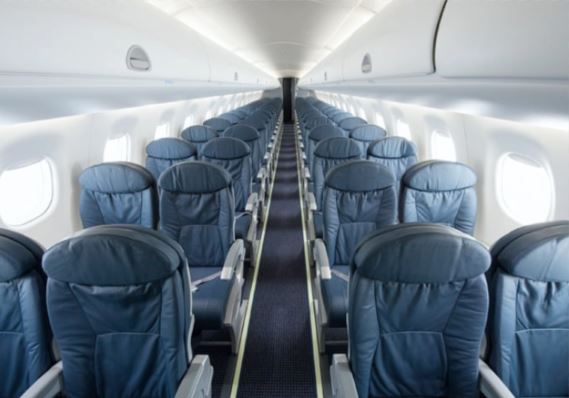
The E175 can accommodate 78 to 88 passengers, depending on the version chosen by the operator. The cabin is spacious, 21.2 m long, 2.74 m wide and 2 m high. The four-parallel seating configuration and interior design of the double-bubble chair offer spacious aisles and seating. Thus allowing passengers to board the plane more easily.

The E175 aircraft cabin with 78 seats configuration has a arrangement of 19 double seats on the left and 20 double seats on the right. This arrangement can be optionally modified to double the first class seat on the right and the first class seat on the left. The cabin also accommodates one observer and two flight attendants. Additional seats for the second observer can be installed optionally.

The E175 aircraft is equipped with two cargo compartments under the floor. Compartments are located in the front and rear wing. The front compartment is bigger, with a volume of 9.92 m3 and a loading capacity of 1,500 kg. The rear compartment is smaller, with a cargo volume of 7.2 m3 and a loading capacity of 1,150 kg. Door nets are installed at each cargo door, while vertical nets can also be optionally installed.

Embraer E175 Cockpit

Embraer E175 Cockpit and Avionics

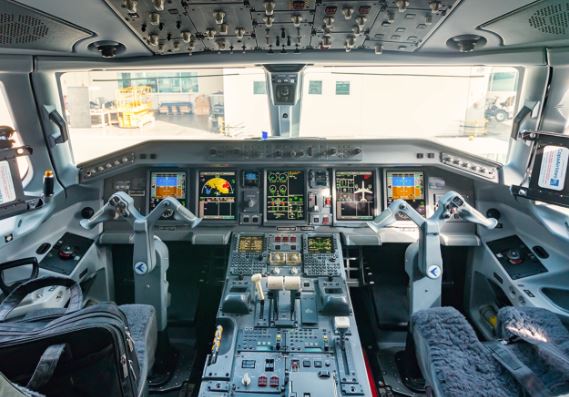
The E175 cockpit has two seats for pilots and co-pilots, with controls and systems that are easily accessible. It's acoustic and thermally insulated. The hand microphone is mounted on the left front door. The circuit breaker is located directly below it. The steering handle is conveniently located next to the hand microphone.

The cockpit is equipped with a series of digital avionics systems, including multifunctional LCDs, guide panels, electronic instrument systems (EIS) and primary flight displays (PFD).

Embraer E175 Price and Orders

The price of the latest Embraer E175 aircraft is around US $ 46 Million. At present, E175 has operated with 12 well-known passenger airlines, including Air Canada, Oman Air, Republic Airlines, Royal Jordanian Airlines, Northwest Airlines, Jet Airways, and others. More than 150 E175 are in operational services.

United Airlines placed a contract for 30 E175 jets in April 2013 and the first aircraft were delivered in April 2014. Mesa Airlines operates new aircraft under the United Express brand. United Airlines booked $ 1.1 billion at Farnborough Airshow in July 2018 for 25 E175 jets.

American Airlines booked $ 2.5 billion for 60 E175 aircraft plus options for 90 more in December 2013. The first aircraft was delivered in February 2015. The airline ordered $ 705 million for 15 E175 aircraft, increasing the total to 104. Shipping scheduled to begin in 2020.

In July 2014, Trans States Holdings ordered 50 E175-E2 jets. The $ 2.4 billion contract also includes an option for an additional 50 units. Deliveries are scheduled to begin in June 2020.

SkyWest placed a $ 301 million order for seven E175 jets in November 2014, as part of a previous order from the company for 100 E-Jets (40 companies and 60 reconfirmables) in 2013. This contract was followed by a new $ 422 million contract awarded in January 2018 for nine E175 jets, increasing the number of orders to 158. Deliveries begin in 2019.