Showing posts with label Military Aircraft. Show all posts

Saturday, 8 February 2020

KB SAT SR-10 Jet Trainer Specs, Engine, and Price

16:06
KB SAT SR-10 Jet Trainer Specs, Engine, and Price – KB SAT SR-10 is a medium sized single-engine jet trainer designed and developed by Modern Aviation Technologies (KB SAT) to meet Russian Air Force pilot training requirements. This aircraft can be used for primary and secondary pilot training, as well as to improve military and commercial pilot piloting skills. This is being developed for the Russian Air Force and for export.

The first test flight of the SR-10 prototype aircraft was carried out at an airport near Vorotynsk in the Kaluga region in December 2015. During the first flight test program, the aircraft's qualitative performance including certain flight characteristics, stability and control, system operation and equipment were assessed. This aircraft is being further tested at the Gromov Flight Research Center in Moscow.

KB SAT SR-10 Jet Trainer

KB SAT SR-10 Specs

the SR-10 jet trainer has an integrated aerodynamic design that allows it to do safe aerobatics. The aircraft comes with moderate wings of inverted strokes which provide greater maneuverability. The main wing is mounted at the center of the fuselage and is swept forward at an angle of 10°. The overall dimensions of the SR-10 aircraft include a length of 9.59 m, a height of 3.55 m, and a wing width of 8.40 m. This aircraft has a maximum take-off weight of 2,700 kg, a normal take-off weight of 2,400 kg, and a normal landing weight of 2,000 kg.

The SR-10 fuselage is built from modern composite materials. The aircraft uses gliders to reduce weight and increase resources in the fuselage. The company claims that this aircraft has very low operating costs compared to other jet trainers. The aircraft is equipped with a retractable tri-cycle landing gear consisting of a single wheel attached to the nose and two main wheels under the fuselage.

KB SAT SR-10 engine

KB SAT SR-10 Engine and Performance

The SR-10 jet trainer prototype is powered by a single Ivchenko AI-25TL turbofan engine that produces power of 16.87 kN (3,790 lb). Meanwhile, the production aircraft are powered by a 1.95 m AL-55 turbofan engine developed by Saturn's NPO, which produces a takeoff thrust of 3,880 lb.

the SR-10 jet trainer can fly with a cruising speed of 520 km/ h, a maximum air speed of 900 km/ h, and a maximum maneuver speed of 700 km/ h. The aircraft has a maximum range of 1,500 km and a service ceiling of 6,000 m with a climbing rate of 60 m/ s. The minimum rotation radius is 290 m and the maximum rational bank speed is 7 r/ s.

KB SAT SR-10 cockpit

KB SAT SR-10 Cabin and Cockpit

SR-10 jet trainer is equipped with dual cabins which provide comfort for the flight crew. The cabin accommodates two crew members, namely a pilot and an instructor, with dual control in tandem configuration. The pilot has unobstructed views through a large canopy. It was equipped with a Class 0-0 ejection seat in the cabin to ensure safety for the crew at all altitudes and piloting speeds.

KB SAT SR-10 Price

The price of the KB SAT SR-10 jet trainer is around US $ 8.32 million. The Russian Ministry of Defense has allocated 2.5 bn RUR ($ 34 million) for the SR-10 development project.

Saturday, 12 October 2019

Yakovlev Yak-130 Jet Trainer Specs, Cockpit, Radar, and Price

01:00
Yakovlev Yak-130 Jet Trainer Specs, Cockpit, Radar, and Price – Yakovlev Yak-130 (NATO reporting name: Mitten) is an advanced two-seat jet trainer and subsonic light fighter aircraft designed and produced by Yakovlev and the Irkut company. The Yak-130 can be used as a light attack aircraft or as a trainer for various fourth or fifth generation fighter jets.

The joint program for the development of coaches between Russian Yakovlev and Italian Aermacchi began in 1993. The Yak/ AEM-130D demonstrators flew in 1996. In 1999, the partnership was dissolved and the Yakovlev Yak-130 and Aermacchi M346 became separate programs.

In the second quarter of 2003, the Yak-130 prototype successfully completed 450 flights, including demonstration flights with high maneuverability such as a 42 ° controlled attack angle.

Yak-130 completed the first phase of a joint state test in April 2009 which included entering basic weaponry. Arrived at the Lipetsk Air Base in February 2010. The aircraft flew in a line of sophisticated digital avionics developed by KRET in June 2014.

Yakovlev Yak-130 Jet Trainer

Yakovlev Yak-130 Specs

The Yak-130 fuselage has a classic swop-wing design and empennage monoplane with lightweight carbon fiber alloy construction. Kevlar armored guards are installed in the engine, cockpit and avionics compartments. The high lift wings which are swept up medium and the low tail plane all move allows the pilot to choose a high angle of attack. The airframe is designed for a 30-year work period with 10,000 flight hours or 20,000 landings.

The Yak-130 jet trainer is equipped with leading edge blades and a three-position Fowler flap, so it can operate on short airfields. Fowler flaps are split flaps that move back and then down the track to provide a large increase in lift and lift height and drag for landing maneuvers.

The Yak 130 trainer can be operated from non-paved runways and small unprepared airfields because the landing gear is designed with a high takeoff. The intricately installed fly-by-wire control system allows the aircraft to feature automatic flight control systems, active flight safety systems, stability training, and control characteristics.

Yakovlev Yak-130 Specs

Yakovlev Yak-130 Engine and Performance

The Yak-130 jet trainer is powered by two AI-222-25 turbofan engines developed under the Russian and Ukrainian programs by Motor Sich, the Zaporozh'e Progress Design Bureau and the Moscow Salyut Motor Building Production Company. Each machine has a thrust of 2,500 kg. Meanwhile, the Yak-130 export variant can be paired with a DV-2SM engine.

The internal fuel tank of Yak 130 trainer, consists of two wing tanks and a central fusel that can carry up to 2,179 l of fuel. With two suspended fuel tanks (450 l each), the maximum total fuel load is 3,100 l. The aircraft is equipped with single point pressure or optional gravity refueling. This training aircraft can be equipped with a refueling probe in flight.

Yakovlev Yak-130 Cockpit

Yakovlev Yak-130 Cockpit and Avionics

The cockpit of the Yak-130 jet trainer has a two-seat tandem configuration. The air-conditioned and pressurized cockpit is equipped with an NPO Zvezda K-36LT3.5 zero-ejection seat. This jet trainer has an all-glass cockpit. Both pilot positions are compatible with night vision goggles (NVG) and are equipped with three multifunctional 6 in x 8 in color liquid crystal screens.

Pilots in the front cockpit can use helmet-mounted vision to designate targets. The cockpit is equipped with internal and external MS communication and a voice warning system provided by AA.S. Popov GZAS joint-stock company. The pilot has a holistic view through the blister canopy. The front pilot has a view to the nose of the aircraft by -16 °, while the rear pilot has a view of -6 °.

The Yak-130 avionics suite is fully digital integrated with Avionica's fly-by-wire flight control system which functions to adjust stability and control characteristics and flight safety systems to simulate a number of fighter aircraft such as MiG-29, Su-27, Su-30, F- 15, F-16, F-18, Mirage 2000, Rafale, Typhoon and future fighters like the F-35.

The pilot chose the software model of the simulation aircraft control system on the Yak-130 on-board computer. Pilots can choose the model during the flight. This system can be forgiving to allow cadet pilots to obtain piloting skills easily. The jet trainer is equipped with an avionics open architecture suite including two computers and a three-channel information exchange multiplexer. The navigation suite includes a laser gyroscope and GLONASS / NAVSTAR global positioning.

Yakovlev Yak-130 Radar

The Yak-130 jet trainer is equipped with 8 GHz to 12.5 GHz Osa or Oca (Wasp) radar, which is supplied by NIIP Zhukovsky. Radar has the capacity to track eight targets in the air simultaneously, simultaneously involving four targets in all angles and simultaneously tracking two ground targets. The detection range of the 5m² cross-section target is 40 km in the back and 85km in the forward direction. The locking range for operation in automatic tracking mode is 65 km. The radar has an adaptive waveform and sidelob, has a surface mapping mode that includes freezing and enlarging the image in the area of ​​interest.

The electronic warfare suite on the Yak-130 combat trainer includes chaff and flare dispensers, radar warning receivers and active jammers.

Yakovlev Yak-130 Weapon

Yakovlev Yak-130 Weapons

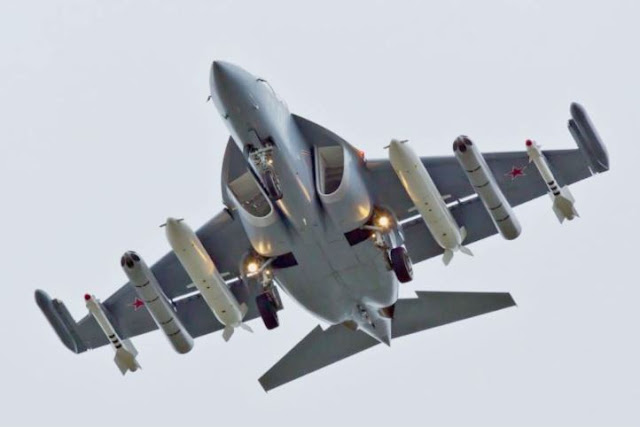
The Yak-130 can simulate the tactics of various existing fighter planes. The aircraft can carry weapons, suspended fuel tanks, surveillance pods and various electronic war pods including radar jammers and infrared countermeasures. There is one diameter of the fuselage line and the number of wing hooks for arms suspension has been increased to eight with six underwings and two wing tips, increasing the weight of combat loads to 3,000 kg.

The open architecture suite installed on the Yak-130 allows a variety of heavy weapons systems, Vikhr laser guided missiles, R-73 infrared guided air-to-air missiles (as NATO 11-Archer), Kh-25 ML (as NAT-10 AS- 10 Karen) air-to-surface laser, AIM-9L Sidewinder, Magic 2 and AGM-65 Maverick missiles. Platan's electro-optical guide pod is mounted under the fuselage for the placement of KAB-500Kr guided bombs.

This fighter training aircraft is equipped with a 30 mm GSh-301 cannon or a GSh-23 cannon mounted under the fuselage. It can also use B-8M and B-18 missiles that are not aimed, bombs 250 kg and 50 kg and cluster bombs.

Yakovlev Yak-130 Price and Orders

The price of the latest Yakovlev Yak-130 advanced jet trainer is US $ 46 Million. In March 2006, it was announced that Algeria had ordered 16 Yak-130 trainers. Deliveries were completed in 2011.

In December 2011, the Russian Ministry of Defense ordered with Irkut for the shipment of 55 Yak-130 combat trainers in 2012. The first batch of six aircraft was sent to the Russian Air Force in October 2012. The second batch of three Yak -130 was delivered in November 2012. A total of 15 aircraft were sent to the Russian Air Force in 2012.

Bangladesh ordered 16 Yak-130s in January 2014. The Russian Ministry of Defense placed orders for the supply of 12 additional aircraft in February 2014. A total of 36 Yak-130 aircraft are expected to be sent to Syria in 2016. Russia also plans to export aircraft to the Azerbaijan military.

Thursday, 10 October 2019

Tupolev Tu-95MS Bombers Specs, Range, Cockpit, Price

01:00
Tupolev Tu-95MS Bombers Specs, Range, Cockpit, Price – Tupolev Tu-95MS (NATO reporting name: Bear-H) is a strategic long-range turboprop-powered bomber developed by Russian aerospace and defense company JSC Tupolev Design Bureau. The operator is currently in service with the Russian Air Force. The Tu-95MS aircraft is a modern version of the Tu-95 Bear strategic bomber. It is equipped with a stand-off cruise missile and can be used in combat missions to defeat cruise missiles and strategic enemy targets.

The first flight test was conducted in May 2011, two Tu-95MS aircraft conducted a 17-hour patrol flight over the Aleutian Islands. This was followed by a 10-hour air patrol flight in the Pacific Ocean in November 2011. Two Tu-95MS strategic bombers also conducted patrol flights over the Aleutian Islands. Arctic Ocean for 20 hours in April 2012. Another patrol flight, which lasted 13 hours, was executed in the Norwegian Sea in November 2013. The Tu-95MS successfully launched six high-precision cruise missiles at ground targets during a 7-hour tactical flight test in June 2014 .

Tupolev Tu-95MS Bear-H Bombers

Tupolev Tu-95MS Specs

The Tu-95MS fuselage is made entirely of metal construction and has a high aspect ratio spar wing design. It was able to engage the main stationary enemy targets under extreme weather conditions both in the day and night. The aerodynamic design of the fuselage allows it to fly at high speeds at safe altitudes. Two large fairings are mounted on the wing to reduce drag. Overall the Tu-95MS has a length of 49.6 m and a height of 13.3 m, and is equipped with a semi-monocoque aircraft.

The Tu-95MS landing mechanism is equipped with a retractable tricycle type landing gear consisting of a controllable two-wheel nose unit and a four-wheeled main unit. The maximum take-off and landing weights are 185 t and 135 t respectively and the maximum load capacity is 20,000 kg. The wing is swept back at 35 ° and the wing span is 50.05 m.

Tupolev Tu-95MS Specs

Tupolev Tu-95MS Engine

Tupolev Tu-95MS bomber is powered by four NK-12MP turboprop engines supplied by the Kuznetsov Design Bureau. Each engine drives an eight-bladed AV-60N counter-rotating propeller. The engine has a takeoff power of 15,000 hp (11,000 kW) and a pressure ratio of 9.7.

The internal fuel capacity of the aircraft is 84 t. Fuel is stored in four integrated tanks in the outer wing, two middle wing tanks, and in the central fuselage tank. An air-to-air refueling probe is mounted on the nose.

The maximum speed of the Tu-95MS is 830 km/ h and the cruising speed is 550 km/ h. This aircraft has a flight range of 10,500 km. This range can be extended up to 14,100 km with one flight refueling. Take-off and landing rolls from the bombers were 2,540 m and 1,700 m respectively, and the service ceiling was 10,500 m.

Tupolev Tu-95MS Weapon

Tupolev Tu-95MS Weapons

The Tu-95MS aircraft is armed with two 23-mm double-barreled Gryazev-Shipunov GSh-23 automatic cannons at the rear for defense against air threats. Each cannon has a shot rate of 2,400 rounds per minute. Six Kh-15 air launch cruise missiles with a range of 2,500 km are carried out in a drum launcher. The aircraft can be further modified to carry up to eight Kh-101 air launch cruise missiles or 14 Kh-65 anti-ship missiles.

Tupolev Tu-95MS Cockpit

Tupolev Tu-95MS Cockpit and Avionics

The Tupolev Tu-95MS bomber aircraft can accommodate seven crew members, including a pilot and co-pilot. The Avionik Tu-95MS suite includes the ANS-2009 celestial navigation system, developed by Concern Radio-Electronic Technologies (KRET), to determine aircraft coordinates. The new generation BINS-SP-2M strapdown inertia navigation system, which was also developed by KRET, determines the location of objects and provides navigation and flight data in the absence of satellite navigation.

The aircraft is also equipped with Leninetz Obzor-MS clam pipe navigation and pulse-doppler radar attacks, and the Mak-UT approach warning system infrared (MAWS). It can be upgraded with new equipment to increase reliability.

The Tu-95MS bomber is equipped with a self-defense system from guided missiles, the SPS-160 Geran Jammer series. Electrical defrosting systems are installed to protect the leading canopies, propellers, pilots and wing tips. The onboard electronic countermeasures (ECM) also includes the Meteor-NM computer-controlled ECM system, APP chaff / flare dispenser and Avtomatika SPO-32/ L150 digital warning receiver.

Tupolev Tu-95MS Price and Orders

The price of the latest Tupolev Tu-95MS Bear-H Bombers is around US $ 26.28 Million. The first production aircraft was deployed by the 121st Heavy Bomber Regiment at the Engels Air Base and the 73rd Heavy Bomber Flight Division at the Ukrainka Air Base.

In December 2014, Tupolev handed over two Tu-95MS strategic bombers that were enhanced with improved avionics and flight efficiency to the Russian Air Force, as part of the country's defense orders. Further shipments of the upgraded Tu-95MS took place in January 2015. The Russian Ministry of Defense bought 20 modern bombers by the end of 2016. The aircraft is expected to continue to operate with them until 2040.

Tuesday, 8 October 2019

Tupolev Tu-22M3 Strategic Bomber Specs, Cockpit, Price

01:00
Tupolev Tu-22M3 Strategic Bomber Specs, Cockpit, Price – Tupolev Tu-22M3 (NATO reporting name: Backfire-C) is a long-range strategic and maritime strike bomber developed by Tupolev for the Russian Air Force. The aircraft is currently in service with the Russian Air Force and Russian Navy Aviation. This aircraft is mainly used to carry out nuclear attacks and conventional attack operations. This can also be used in anti-ship missions and maritime surveillance.

The earliest pre-production aircraft produced was the Tu-22M0. Its production is limited to a small amount due to inadequate performance. Then followed by the Tu-22M1 pilot production aircraft for the Russian Naval Aviation. Production in the first major production version, the Tu-22M2 began in 1972. It was equipped with extended wings and a redesigned fuselage, twin engines and new undercarriage.

The Tu-22M3 is based on the Tu-22M aircraft design. The first Tu-22M0 prototype completed its maiden flight in August 1969. The Tu-22M1 first flew in July 1971 and the Tu-22M was first used in combat missions in Afghanistan between 1987 and 1989. The Tu-22M3 was used by Russia for combat operations in Chechnya in 1995.

The Tu-22M3 is introduced with enhanced features to overcome the disadvantages of its predecessor. This aircraft completed its first flight in June 1977 and was installed in inventory in 1983. Some Tu-22Ms were also modified to Tu-22MR and Tu-22ME standards. The Russian Ministry of Defense intends to increase up to 30 aircraft from around 60 Tu-22M3 which are currently in service to the advanced Tu-22M3M variant. The first modernized aircraft was launched during the launch ceremony at the Kazan Aviation Plant. It made its maiden flight on December 28, 2018.

Tupolev Tu-22M3 Strategic Bomber

Tupolev Tu-22M3 Specs

The Tupolev Tu-22M3 incorporates a variable wing length design. This aircraft has a stepped cockpit and variable-geometry outer wing panels. The tail fin is swept back and tapered with a square tip. Flats mounted in the middle of the body are shown with a blunt end and each wing includes a middle and two outer panels. The outer wing attaches to the center through a hinged joint.

Overall, the Tu-22M3 has a length of 42.4 m, a maximum wing span of 34.2 m, and a height of 11.05 m. The maximum empty weight and takeoff weight of the aircraft are 53,500 kg and 126,400 kg, respectively.

The Tupolev Tu-22M3 is equipped with a tricycle landing gear to support operations on unprepared runways. The nose includes twin wheels that are pulled back. Each main landing unit consists of six wheels in a 2 × 3 bogie arrangement. These are pulled directly into the fuselage.

Tupolev Tu-22M3 Specs

Tupolev Tu-22M3 Engine

The Tu-22M3 is powered by two Kuznetsov NK-25 turbofan engines mounted on the body with large air intakes and dual exhausts. Each engine produces a maximum thrust of 25,000 kg and results in better fuel savings.

The Tupolev Tu-22M3 has a cruise speed of 900 km/ h and a maximum speed of 2,300 km/ h. This aircraft can fly at a maximum altitude of 14,000 m and the level of climbing aircraft is 15 m/ s. The operational range of the aircraft is 7,000 km. This aircraft can be equipped with refueling probes to enable refueling in flight for longer distances.

Tupolev Tu-22M3 Cockpit

Tupolev Tu-22M3 Cockpit and Avionics

The Tupolev Tu-22M3 semi-glass cockpit can accommodate four crew members on an ejection seat that leads upwards. This is equipped with a special panel for pilots, navigator-operators and commanders, with entrances provided through individual doors. The pressurized cockpit is equipped with a climate control system.

Tupolev Tu-22M3 Sensor and Radar

The Tupolev Tu-22M3 aircraft is equipped with a PN-A/ PN-AD blasting-navigation radar system, an Argon-2 radar fire control system and a TV-based bomb backup optical sight. Countermeasures are provided by updated radar warning receivers, radio frequency jammers, and defensive countermeasures.

Tupolev Tu-22M3 Engine

Tupolev Tu-22M3 Weapons

The Tupolev Tu-22M3 aircraft has a number of hard points that can be armed with Kh-32 missiles which are sophisticated derivatives of Raduga Kh-22 or US-4 Kitchen Cold War era, Kh-15 or Kh-15P anti-radar missiles, and bombs dropped free FAB-250 or FAB-1500. Wingparts and fuselage and internal weapons chambers are provided with the capacity to carry 24,000 kg of cargo. The aircraft is also armed with a GSH-23 double barrel (23 mm) pistol in the tail tower that is controlled remotely.

Tupolev Tu-22M3 Price

The price of the latest Tupolev Tu-22M3 Strategic Bomber is around US $ 40 Million.

Sunday, 6 October 2019

Tupolev Tu-160 Strategic Bomber Specs, Speed, Cockpit, Price

01:00
Tupolev Tu-160 Strategic Bomber Specs, Speed, Cockpit, Price – Tupolev Tu-160 (NATO reporting name: Blackjack) is a supersonic strategic bomber produced by the joint research company and the Tupolev Moscow aircraft complex and the Kazan-Gorbunov Aircraft Production Association in Tatarstan from 1980 to 1992. The Tu-160 flight test was completed in December 1981 and began operations in April 1987. Production has resumed and a Tu-160 was sent to the Russian Air Force in May 2000. About 35 aircraft were built out of which only 16 were in service in Russia.

The Tu-160 is designated as White Swan because of its maneuverability and anti-flash white finish. The purpose of this aircraft is the delivery of nuclear and conventional weapons deep within the theaters of continental operations. This aircraft is capable of operating in all weather, day and night and can operate at all geographical latitudes. The modern variant of the Tu-160M2 is equipped with the latest generation Russian cruise missiles and a new engine designed by the Kuznetsov Design Bureau, which is reported to significantly expand the range of aircraft.

Tupolev Tu-160 Blackjack Strategic Bomber

Tupolev Tu-160 Specs

The Tu-160 bomber airframe has a distinctive appearance, with the wings and fuselage gradually being integrated into a one-part configuration. The fuselage structure is based on titanium beams, twisted boxes all of which are welded. Throughout the entire fuselage, all main fuselage members are secured to titanium beams.

The tapered wings outside variable geometry sweep back from 20 ° to 65 ° to provide high-performance flight characteristics at supersonic and subsonic speeds. Tail surfaces, horizontal and vertical, all intact and all moving.

The Tu-160 uses fly-by-wire control. The aircraft is equipped with a three-strut landing gear, tail wheel and parachute brake. It can attack strategic targets with nuclear and conventional weapons in the theater of continental operations. For take-off, the aircraft requires a 3,050 m concrete runway. The aircraft weighs around 110,000 kg and its maximum take-off weight is 275,000 kg.

Tupolev Tu-160 Engine

The Tupolev Tu-160 is powered by four Kuznetsov NK-321 turbofan engines, each of which provides a maximum thrust of 25,000 kg. The engine is mounted on two pieces under the shoulder of the wing. Air intake combines vertical slices that can be adjusted.

The bomber has a refueling system in flight. In the non-operational position, the refueling probe is pulled into the nose of the aircraft in front of the pilot cabin. The fuel capacity of the aircraft is 160,000 kg.

The maximum speed and cruise speed of the Tupolev Tu-160 are 2,220 km / h and 960 km / h, respectively. This aircraft can ride at a speed of 70 m / sec. The aircraft's distance is 12,300 km. The combat radius is 7,300 km. Service ceiling is 16,000 m. Tu-160 has a flight endurance of 15 hours.

Tupolev Tu-160 Cockpit

Tupolev Tu-160 Cockpit and Avionics

The Tu-160 cockpit can accommodate 4 crew members, consisting of a pilot, co-pilot, a navigator and an operator. All four crews are equipped with zero / zero ejection seats, which gives the crew the option to safely issue all levels of altitude and airspeed, including when the aircraft is parked. All flight data are presented on conventional electro-mechanical indicators and monitors, and not head-up displays or cathode ray tube displays.

Tu-160 flight control is carried out with a control stick as used in fighter aircraft, not a control wheel or yoke normally used on large transport aircraft or bombers.

The Tu-160 avionics system includes an aiming navigation system, integrated flight navigation and control, with navigation and attack radars, an electronic countermeasure system, and automatic control. So that makes this bomber very computerized.

Tupolev Tu-160 Specs

Tupolev Tu-160 Weapons

Tu-160 bombers can carry nuclear and conventional weapons including long-range nuclear missiles. The missiles are housed in multi-station launchers in each of the two arms bays. In addition, the Tu-160 can also be armed with a strategic cruise missile Kh-55MS, which is known in the West by NATO designation and the US code name Kent. Up to 12 Kh-55MS missiles can be carried, six in each bay. The Kh-55MS is driven by a turbofan engine. The maximum distance is 3,000 km, and armed with 200 kt nuclear warheads.

The bay of weapons is also equipped with a launcher for the Kh-15P, which has the name NATO and code name AS-16 Kickback. The Kh-15P Kickback has solid rocket fuel propulsion, which provides a range of up to 200 km. The kickback can be fitted with conventional 250kg warheads or nuclear warheads. This aircraft is also capable of carrying various air bombs with a total weight of up to 40 tons.

Tupolev Tu-160 Price

The price of the Tupolev Tu-160 Blackjack Strategic Bomber is around US $ 70 Million. Russian President Vladimir Putin through the Ministry of Defense awarded Tupolev a contract to purchase 50 units of the latest Tu-160M2 variant. The cost of this first contract is 160 billion rubles (nearly US $ 2.8 billion), and sets the first Tu-160M2 shipment in 2023. The last bomber delivery on the first purchase, according to the contract, is scheduled for 2027.