Sunday, 8 September 2019

Hongdu L-15B Specs, Engine, Cockpit, and Price

01:00
Hongdu L-15B Specs, Engine, Cockpit, and Price – Hongdu L-15B is a new twin-seat combat trainer developed by the Hongdu Aviation Industry Group (HAIG), part of the China Aviation Industry Corporation (AVIC), for the People's Liberation Army Air Force (PLAAF). This is an advanced variant of the L-15 supersonic trainer / attack aircraft.

HAIG presented a mock-up from the L-15B trainer at Zhuhai Airshow which was held in November 2016. The trainer was inaugurated by HAIG at its headquarters in Nanchang, China, in May. L-15B combat training aircraft can carry out advanced training, primary combat training (LIFT), air defense, and air-to-ground attack missions.

Hongdu L-15B combat trainer

Hongdu L-15B Specs

The L-15B jet trainer is equipped with a mixed wing body configuration and a medium aspect ratio with leading edge for improved aerodynamic performance. Empennage includes a single vertical tail and a horizontal full motion tail.

The L-15B aircraft is equipped with a retractable three wheel landing gear wheel, including a single nose wheel unit and two main wheel units. Overall the L-15B aircraft has a length of 12.4 m and a height of 4.7 m, a wingspan of 9.4 m, and a maximum takeoff weight of 11.6 t.

With a design life of 10,000 hours, this trainer aircraft offers superior flight performance and safety, a wide operating envelope, and a high cost efficiency ratio.

Hongdu L-15B Engine

The L-15B jet trainer is powered by two Ivchenko Progress AI-222-25F turbofan engines with afterburners. The machine is equipped with a full authority digital engine control system (FADEC).

The maximum speed of the L-15B combat trainer is Mach 1.4. This aircraft has an operational range of 2,600 km, which can be extended by integration of a fuel drop tank.

Hongdu L-15B cockpit

Hongdu L-15B Cockpit and Avionics

The sophisticated glass cockpit of the L-15B jjet trainer has a head-to-top display for the front cockpit, a head-to-bottom display for the rear cockpit. Both cockpits are equipped with multi-color screens and hands-on-throttle-and-stick flight control (HOTAS). It accommodates two crew members, including a student pilot in the front seat and an instructor in the back in a tandem layout.

The modern cockpit of the L-15B is covered by a large glass canopy and offers pilots superior space, comfort and a field of view. The aircraft is also equipped with a digital three-axis fly-by wire system, which allows pilots to simulate flight characteristics of some of the most modern fighter jets.

The advanced avionics suite of the L-15B jet trainer ensures student pilots to handle the complex digital cockpit of modern Chinese fighters. The nose of the aircraft is equipped with an electronically scanned radar array (PESA). The PESA X-band radar can guide air-to-air and air-to-ground missiles to a maximum range of 111 km.

The L-15B jet trainer integrates a radar warning receiver (RWR) in a vertical stabilizer. The nose also features a fin antenna for friend or foe identification systems (IFF). It can also be equipped with a special electronic warfare pod.

Hongdu L-15B specs

Hongdu L-15B Weapons System

The fighter version of the L-15B aircraft can carry a 3,500 kg weapons load at nine hard-points. Each wing has three hard points, while each wing tip accommodates one hard point. Under the fuselage also has a hard point for transporting weapons.

L-15B fighter aircraft can be armed with a variety of weapon systems such as PL-10 infrared-homing, short range, air-to-air missiles, active PL-12, radar guided, out of visual range, air-to-air missiles, and PL missiles -8 infrared-guided, short-range, air-to-air, as well as LT-2 lasers and precision-guided LS-6 bombs.

Hongdu L-15B Price

The price of the latest Hongdu L-15B jet trainer is US $ 15 Million.

Friday, 6 September 2019

FTC-2000G Specs, Engine, Cockpit, and Price

01:00
FTC-2000G Specs, Engine, Cockpit, and Price – The FTC-2000G is an advanced multi-role trainer/ combat aircraft designed and manufactured by Guizhou Aviation Industry Corporation (GAIC) under the auspices of aerospace and state-owned defense company China Aviation Industry Corporation of China (AVIC). This aircraft is an export variant of the Guizhou JL-9 (FTC-2000) trainer/ fighter aircraft, which operates with the People's Liberation Army Air Force (PLAAF) and the People's Liberation Army Navy (PLAN). The FTC-2000G jet trainer made its first flight in September 2018.

The FTC-2000G jet trainer offers a variety of capabilities to operators and can seamlessly switch between the role of fighter jets and coach aircraft based on mission requirements. This aircraft can be used to conduct pilot flight training, air surveillance, patrol missions, reconnaissance, electronic warfare, close air support, and air escort missions.

The FTC-2000G jet trainer combines training capabilities with attack and battle capabilities to offer a strong platform for military forces on the battlefield. It can replace existing second generation aircraft such as F-7 fighter jets, A-5 aircraft, Alpha Jet, and FT-7 trainer aircraft.

FTC-2000G jet trainer

FTC-2000G Specs

The FTC-2000G fuselage design is based on the FTC-2000 aircraft. The wings of the aircraft are mounted low into the extended plane. The stabilizing structure of the tail assembly is mounted on the fuselage in a conventional manner. The sharp nose of the FTC-2000G and aerodynamic features further enhance the aircraft's performance during strong winds and bad weather conditions.

The landing feature of the FTC-2000G jet trainer is a tricycle that can be pulled with a gear unit. A single wheel is placed under the nose and two other wheels are placed under the fuselage. Overall the FTC-2000G jet trainer has an overall length and height of fixed wing aircraft of 15.4 m and 4.8 m respectively, while the wingspan is around 10 m.

FTC-2000G specs

FTC-2000G Engine

The FTC-2000G jet trainer is powered by the latest generation of advanced Guizhou Liyang WP-13 engines. The maximum speed of the FTC-2000G that can be reached is 1,470 km/ h (1.2 Mach). It can reach a maximum distance of 1,650 km without additional air and fuel supply. The aircraft can stay in the air for more than two hours while conducting air operations.

The FTC-2000G jet trainer can operate at a maximum altitude of 15 km. This fighter trainer aircraft has landing speeds and takeoff speeds of 210 km/ h and 230 km/ h, respectively. The aircraft can operate at low speeds and low altitudes in high transonic regions. 410 m running distance for smooth take-off and 580 m for landing. It has a normal take-off weight of 8,000 kg and a maximum take-off weight of 11,000 kg.

FTC-2000G Cockpit and Avionics

The FTC-2000G jet trainer cockpit accommodates two crew members in tandem seating arrangements. The cockpit is covered by a two-piece glass canopy. Large and transparent aircraft canopies offer a clear view of the environment and increase pilot situational awareness. This aircraft is equipped with a modern avionics suite, including modern radar equipment, communication devices, and fire control systems.

FTC-2000G weapon

FTC-2000G Weapons System

The fighter version of the FTC-2000G aircraft integrates up to seven hard points under the wings and fuselage parts to accommodate various ammunition. It also features a surveillance pod and electronic warfare equipment to participate in the desired mission. This aircraft can be armed with missiles, rockets and bombs. It has the capacity to carry up to 3 tons of weaponry in one operation.

FTC-2000G Price

The price of the latest FTC-2000G jet trainer is around US $ 8.5 Million.

Wednesday, 4 September 2019

Calidus B-250 Specs, Engine, Cockpit, and Price

18:02
Calidus B-250 Specs, Engine, Cockpit, and Price – The Calidus B-250 is a next-generation attack/ trainer aircraft developed by Calidus in collaboration with Brazilian companies Novaer, Rockwell Collins and Pratt & Whitney Canada. It was specifically designed to serve the needs of light combat and air force training throughout the world. Calidus launches B-250 aircraft at Dubai Airshow in November 2017.

The B-250 military trainer aircraft can support counterattack operations, reconnaissance, and search and rescue (SAR) operations. It can further simulate close air support (CAS), and environmental intelligence, surveillance and reconnaissance (ISR) missions during combat training activities.

The B-250 program was launched in 2015 and the first prototype was developed within a period of 25 months, completing its maiden flight in July 2017. Calidus plans to build manufacturing facilities in Al Ain City to facilitate full scale production of the B-250 aircraft.

Calidus B-250 trainer aircraft

Calidus B-250 Specs

The Calidus B-250 aircraft has a length of 10.88 m and a height of 3.79 m with a wingspan of 12.1 m and a distance of 3.1 m between the wheels. The B-250 fuselage is made of carbon fiber designed by Novaer. Compact airframe reduces aircraft weight and improves maneuverability while extending service life. The low wing configuration of the aircraft enables it to produce more lift and significantly reduce drag. Crew safety is ensured by an optional ballistic protection system.

The Calidus B-250 aircraft integrates a tri-cycle under-fuselage landing gear that can be drawn with three single-wheeled units. Strengthened landing gear enables operation of rough airfields and unprepared strips. This aircraft can be mounted with the Wescam MX-15 optronic tower, and seven hard points to carry various weapon systems.

Calidus B-250 specs

Calidus B-250 Engine

The Calidus B-250 aircraft is powered by Pratt and Whitney PT6A-68 turboprop engines equipped with multi-stage axial and one-stage centrifugal compressors. Combined with a single bladed four-blade propeller, the engine has a maximum power production capacity of 1,600 hp.

The power plant allows airplanes with a maximum speed of 301 k. This aircraft can reach a maximum altitude of 30,000 feet (9,000 m) in a short span of time. It was designed to carry a maximum load of 1,796kg and cover a maximum distance of 4,500 km. The maximum autonomy or endurance offered by the aircraft is 12 hours.

Calidus B-250 cockpit

Calidus B-250 Cockpit and Avionics

The Calidus B-250 cockpit is a sophisticated open architecture cockpit model that can accommodate two crew members in a tandem configuration. It was equipped with two zero-zero ejection seats developed by Martin Baker. A fully pressurized, air-conditioned cockpit integrates an installed oxygen-producing system (OBOGS) to support long-distance missions.

The sophisticated avionics suite of the B-250 military training aircraft is supplied by Rockwell Collins Proline Fusion. Avionics includes a large multi-function display screen, touch screen technology, digital head-up display (HUD), and intuitive icons.

The avionics suite collects information from on-board sensors and displays real-time information about runways, taxiways, complex intersections, and aircraft locations. This information will increase the situational awareness of the pilots. The Avionics also integrates a fully automatic Multiscan weather radar, which provides crew members with information about weather conditions.

Calidus B-250 Price

Currently the price of the Calidus B-250 aircraft has not been made public, because the aircraft is still under development.

Monday, 2 September 2019

Aermacchi M-346 Master Jet Trainer Specs, Cockpit, and Price

01:00
Aermacchi M-346 Master Jet Trainer Specs, Cockpit, and Price – The M-346 is an advanced fifth-generation fighter jet trainer developed by Alenia Aermacchi (Italy), a Finmeccanica company. The M-346 jet trainer provides combat pilot training for front-line fighters with high angle-of-attack capability. The first low-cost M-346 (LRIP) aircraft made its first flight in July 2008. The advanced version, equipped with a sophisticated helmet-mounted display system, completed its first flight in May 2010.

Aermacchi M-346 Master Jet Trainer

Aermacchi M-346 Specs and Engine

The M-346 aerodynamic design uses a vortex lift to provide maneuverability and control capability at very high attack angles using a fly-by-wire control system. The M-346 jet trainer is powered by two Honeywell / ITEC F124-GA-200 turbofan engines manufactured with Fiat Avio. The machine is equipped with a closed circuit, independent aerobatic lubrication system and Dual Control Digital Motor Channels (FADEC).

The maximum speed and M-346 jet trainer cruising are 1,092 km / h and 1,059 km / h, respectively. The kiosk speed is 166 km / hour. The aircraft can ride at speeds of 127 m / s. The service range and ceiling of M-346 are 2,590 km and 13,700 m, respectively. The runway is 320 m, while the landing is 470 m. This aircraft weighs around 4,610 kg and the maximum take-off weight is 9,000 kg.

Aermacchi M-346 Weapons System

The M-346 Master is carried out at nine external store stations, six of which are underwings, equipped with a 1,000 lb class ejector release unit, and two wingtip stations for air-to-air missiles. Stations below the fuselage carry avionic pods or 300-liter conformal fuel tanks.

Weapons carried by M-346 aircraft include: MK82 500 lb and MK83 1,000 lb bombs that are free falling or retarded; rocket launcher; AIM-9 Sidewinder short-range air-to-air missiles; Raytheon AGM-65 Maverick air-to-ground missile; MBDA (formerly Alenia) Marte MK-2A anti-ship missile.

External hard spots can also carry the Vinton VICON-601 reconnaissance pod, laser pointer pod, radar warning receiver pod and Elettronica ELT-55 electronic countermeasure pod.

The data presentation system and control functions of the store management system use one of the multifunctional displays in both cockpits. Hand throttle and stick control (HOTAS) is used to select weapons. The weapon sights are controlled by the central main processor, aiming at the data presented to the pilot through a head-up display (HUD) or helmet-mounted display (HMD).

For the role of combat trainer, the M-346 is equipped with a self-protection system and a simulated tactical scenario threat on a multifunctional display. As for operational roles, the aircraft is equipped with radar warning receivers, chaff dispensers and flares, and active electronic countermeasures.

Aermacchi M-346 cockpit

Aermacchi M-346 Cockpit and Avionics

The M-346 jet trainer cockpit is representative of the latest generation of fighter aircraft, and each crew position is equipped with a raster / stroke type (HUD) head-up display, full liquid crystal multi-function display (three in each cockpit), helmet mounted screens with threat simulation capabilities, compatible night-vision goggle (NVG) instrumentation and practical throttle and stick (HOTAS) control. The cockpit is also equipped with a MK16 ejection seat from Martin Baker of Uxbridge, England.

The M-346 avionics jet trainer suite is based on a dual-redundant, MIL-STD-1553B digital data bus with capacity for additional systems. The communication package includes a VHF / UHF transceiver and enemy information friend transponder (IFF). The navigation suite includes a gyro laser inertia navigation system with an embedded GPS receiver, and tactical air navigation (TACAN) and VHF omnidirectional radio coverage (VOR / IIS / MB).

The flight control system (FCS) is a digital digital fly-by-quadruple-redundant full-authority system, which includes four Italian BAE Systems flight control computers. FCS provides high control capability on aircraft up to an angle ofattack (AoA) of 35 ° and higher, g-restriction, stall and rotation prevention, and maximum AoA limits.

It can be adapted to various levels of automation and autopilot modes with a reversing mode that displays automatic selection in the event of a breakdown or failure.

Aermacchi M-346 specs

Aermacchi M-346 Price and Orders

The latest M-346 Master jet trainer price is around US $ 21 Million. The Italian Air Force (ITAF) is the first customer to receive 15 M-346 Master jet trainer. Alenia Aermacchi signed a € 220 million ($ 330 million) contract with ITAF in June 2009 to supply six M-346 jets. The first two of the six M-346 aircraft were launched in December 2010.

ITAF appointed the M-346 as the T-346A, which made its maiden flight in March 2011. The Directorate General of Aeronautical Weapons of the Ministry of Defense issued military certification for the M-346 jet on June 22, 2011. The first T-346A aircraft was received by ITAF in November 2011, while the second was sent in February 2012.

In February 2009, the UAE announced it would acquire 48 advanced M-346 warplanes. Alenia Aermacchi intended to form a joint venture with Mubadala Development in the UAE to build the final assembly line M-346.

ST Aerospace signed a € 170 million contract with Alenia Aermacchi on June 24, 2011 to provide logistical support to 12 M-346 trainers deployed by the Republic of Singapore Air Force (RSAF). Jet M-346 was ordered by RSAF in September 2010 under the Fighter Wings Course program. The first aircraft were launched in August 2012 and deliveries were completed in March 2014.

The Polish Ministry of Defense ordered with Alenia Aermacchi in February 2014 for the delivery of eight M-346 Master jet trainer. The first two aircraft were delivered in November 2016. Poland ordered four additional M-346 trainers along with options for four more, in January 2018. Deliveries are expected to be completed by 2022.

Saturday, 31 August 2019

Aermacchi M-345 Jet Trainer Specs, Cockpit, Engine and Price

01:00
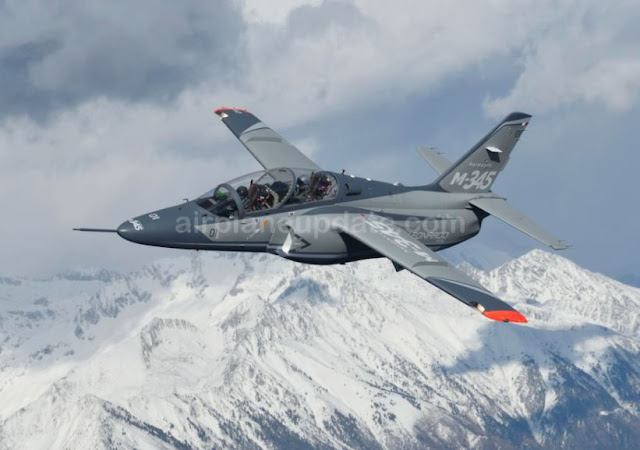
Aermacchi M-345 Jet Trainer Specs, Cockpit, Engine and Price – The M-345 is a light jet trainer developed by Alenia Aermacchi (Italy) for basic-advanced pilot training. This new aircraft is designed to meet various training requirements of the armed forces around the world. The first flight of the M-345 aircraft took place in December 2016. The M-345 will replace the old MB-339 fleet currently operating with the Italian Air Force.

Aermacchi M-345 Jet Trainer

Aermacchi M-345 Specs

The M-345 jet trainer is a lightweight tandem twin shoulder wing aircraft. The reinforced fuselage offers a fatigue period of 15,000 flight hours. It integrates a retractable three wheel landing gear and a single turbofan engine.

The M-345 jet trainer has an overall length of 9.85 m, a wing width of 8.47 m, and a height of 3.74 m. This aircraft has an empty weight of 3,300 kg, a maximum take-off weight of 4,500 kg, and a wing area of ​​12.6 m². The ability to carry external loads makes the M-345 suitable for secondary missions.

Enhanced features of the M-345 include integrated pressure refueling and a two-level maintenance concept, which minimizes operating costs. Together with the on-board jet trainer oxygen-producing system (OBOGS), the operator can reduce the workforce needed for onshore maintenance, and completion time to do more sorting per day.

This jet trainer is equipped with a health and use monitoring system (HUMS) on board the aircraft to provide information about structures, engines and other systems, as well as monitoring the operational status of each single component/ system.

Aermacchi M-345 specs

Aermacchi M-345 Engine

The M-345 jet trainer is powered by a turbofan engine that develops a maximum thrust of 1,600 kg (3,500 lb) at takeoff. Fuel is supplied by an internal tank with a storage capacity of 700 kg. The new M-345 HET variant is powered by Williams International's FJ44-4M engine, which offers improved fuel efficiency.

The M-345 jet trainer cruising speed is 740 km/ h. The certified aircraft service ceiling is 40,000 feet. This aircraft has a climbing rate of 5,400 feet / minute and has a standard range of 840 nm, but the range of the ferry can be extended to 1,100 nm by integrating two external tanks (10% reserve).

The M-345 jet trainer has a limit load factor of + 7/ -3.5 g with a take-off weight of 3,300 kg. The required length of the ground run for aircraft take-off and landing are 460 m and 450 m, respectively.

Aermacchi M-345 cockpit

Aermacchi M-345 Cockpit and Avionics

The M-345 trainer's sophisticated glass cockpit can accommodate two crew members in a tandem configuration. The fully digital glass cockpit is equipped with hands on throttle-and-stick control (HOTAS) and three 5 in x 7 in LCD multi-function displays (MFD) for instructors and student pilots. The front cockpit is equipped with a head up display (HUD), while the rear cockpit is fitted with a HUD repeater.

The cockpit features of the M-345 include night vision goggles (NVGs) compatibility, integrated global positioning systems (GPS) or inertial navigation systems (INS), digital moving maps, and two mission computers. The jet trainer is also equipped with a tactical simulation suite and store management system (SMS).

Aermacchi M-345 Price and Orders

The latest M-345 jet trainer price is around US $ 26 Million. The Italian Air Force ordered 13 M-345 aircraft in June 2019 with a value of € 300 million ($ 338.5 million). Delivery of the first aircraft is expected to take place in 2020.