Sunday, 20 October 2019

Bombardier Dash 8 Q400 Specs, Interior, Cockpit, and Price

01:00
Bombardier Dash 8 Q400 Specs, Interior, Cockpit, and Price – Bombardier Dash 8 Q400 is one of the quietest turboprop aircraft in the world developed by Bombardier Aerospace De Havilland Canada. The development of this aircraft is intended to meet the requirements of regional airlines for larger aircraft on high density routes and short distances. Q400 is the largest member of the Dash 8 family that can accommodate up to 80 passengers.

The Q400 program was launched in 1995 as a broad version of the Q300 series. The first flight of the Q400 aircraft was carried out in 1998 and entered commercial service in February 2000. The aircraft was equipped with a noise and vibration suppression (NVS) system introduced in the Dash 8 turboprop family in 1996.

The latest variant of the Q400 aircraft, the Q400 NextGen, was announced in March 2008. The new aircraft has improvements in the cabin environment, including LED lighting, new ceiling panels, sidewall windows and larger bins. Q400 NextGen participated in the 2012 FIDAE Air Show held in Santiago, Chile in April 2012.
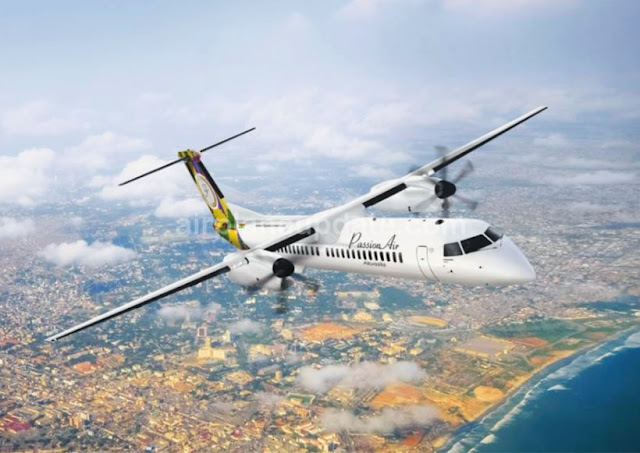
Bombardier Dash 8 Q400

Bombardier Dash 8 Q400 Specs

The transverse section near the circle of the fuselage and the tail section are manufactured by Mitsubishi. The wings, tail plane, and front end of the fins are equipped with a de-icing system. The Q400 aircraft is equipped with a R408 type six bladed composite propeller supplied by Dowty. The propeller is equipped with an electric current removal system. Overall, the Q400 aircraft has a length of 32.84 m, a height of 8.36 m, and a wing span of 28.42 m.

In terms of electricity, the Q400 aircraft powered by an Allied Signal electric power system includes two starter / generators for DC power, two transformer units and two nickel cadmium batteries. There are two engine-driven AC generators to supply variable frequency AC power.

The Q400 aircraft landing mechanism features a retractable Menasco tricycle type landing gear. Each unit has twin wheels equipped with Goodrich anti-skid brakes. Two independent hydraulic systems are supplied by Parker Bertea Aerospace.

The fuel tank located on the wing of the aircraft has a total capacity of 6,526 l. The Q400 test aircraft became the first Canadian aircraft to fly using D7566 bio-fuel. D7566 is certified by the American Society for Testing and Materials (ASTM). Porter Airlines is Canada's first biofuel-powered revenue flight on its Q400 aircraft.

Bombardier Dash 8 Q400 Engine and Performance

The Q400 aircraft is powered by two PW150A turboprop engines supplied by Pratt & Whitney Canada. Each engine is capable of producing an output power of 5,071 shp or 3,800 kW. The engine is equipped with full digital engine control (FADEC). With the support of the PW150A engine, the Q400 is capable of flying with a maximum cruise speed of 650 km / h with a maximum distance of 2,519 km.

Bombardier Dash 8 Q400 cockpit

Bombardier Dash 8 Q400 Cockpit and Avionics

The Q400 aircraft is equipped with a dual control cockpit that can accommodate pilot and co-pilot. The cockpit is integrated with an electronic flight instrumentation system (EFIS) with five high-resolution LCDs, 6 in x 8 in to display all flight information. The cockpit is also equipped with an emergency locator transponder, solid state cockpit voice recorder, and a holographic guidance system from Flight Dynamics.

The avionics suite of Q400 aircraft supplied by Thales Avionics includes a flight management system, global positioning system and a traffic warning and collision avoidance system, TCAS II. The aircraft communication suite includes dual VHF navigation and S communication and transponder mode. Navigation equipment includes weather radar, proximity proximity warning receivers, radar altimeters, automatic direction finders, and distance measuring equipment.

Bombardier Dash 8 Q400 interior

Bombardier Dash 8 Q400 Cabin and Interior

The Q400 aircraft cabin can be configured for a class or two class layout that can hold 68 to 78 passengers. Meanwhile, cabin with business class configurations can only accommodate 58 seats. The cabin is equipped with an air ladder mounted at the front of the cabin, allowing the aircraft to use the airport with limited ground support facilities. Two passenger doors and one service door allow the aircraft to get up and down quickly. This aircraft provides more than 14 m³ of baggage space.

Bombardier Dash 8 Q400 Price and Orders

The price of the latest Bombardier Dash 8 Q400 aircraft is around US $ 32.2 Million. More than 413 Q400s have been ordered, with 389 delivered in December 2011. Major operators include: SAS Commuter (launch customer), Augsburg Airways from Germany, Horizon Air USA, Austrian Tyrolean Airways, Qantas Airways, Horizon Air, Flybe, Colgan Air / Pinnacle , Porter Airways and All Nippon Airways Japan. Meanwhile orders for the NextGen Q400 include 20 aircraft from Eurolot in March 2012, five aircraft for Ethiopian Airlines and two for Horizon Air in February 2012.

Friday, 18 October 2019

Bombardier Dash 8 Q300 Specs, Interior, Cockpit, and Price

01:00
Bombardier Dash 8 Q300 Specs, Interior, Cockpit, and Price – Bombardier Dash 8 Q300 is a regional aircraft turboprop engine that was introduced in 1998 by Bombardier Aerospace De Havilland Canada. This aircraft can accommodate up to 56 passengers. This Bombardier aircraft is equipped with a noise and vibration suppression system (NVS). NVS technology was introduced to the Dash 8 turboprop family in 1996 and the Dash 8 aircraft series was renamed the Q series.

The Dash 8 Q series family also includes Q100 (37 seats), Q200 (39 seats) and Q400 (68 to 78 seats). The Q300 has a larger fuselage and wingtips added and has a more powerful engine compared to the Bombardier Q200 aircraft. The Q300 aircraft variant consists of Q300MSA for maritime and Q300HGW for heavy transport. Maritime task variants are equipped with crew station interiors, large conformal observation windows, and structural fuselage mods. While the heavy duty variant is equipped with a more powerful engine and greater payload capacity.

Bombardier Dash 8 Q300

Bombardier Dash 8 Q300 Specs

The Q300 aircraft is an extended version of the Q200 aircraft. The overall length of the fuselage length is 25.7 m. The fuselage is almost circular in the transverse section. The upper center line of the fuselage carries a large dorsal fin which blends with the swept T-vertical tail fin. This aircraft has conventional and powered flight controls, as well as digital automatic flight control systems. The Q300 aircraft is equipped with a tricycle-type landing gear drawn by Dowty Aerospace equipped with twin Goodrich wheels and brakes. The landing gear is equipped with the Hydro-Aire mk3 anti-skid unit.

The Q300 aircraft can be equipped with an optional Turbomach T-40 additional power unit. The DC power unit consists of two sets of starters / generators, two sets of transformers and rectifiers and two nickel cadmium batteries. This aircraft is equipped with a DC outlet mounted on the nose on the port side. The aircraft's AC power system consists of two engine-driven AC generators with three static inverters. A grounded AC outlet is installed on the rear right side nacelle engine.

This aircraft has two hydraulic systems that operate independently. Each hydraulic system consists of an engine-driven displacement pump, an electrically powered standby pump, an accumulator and a manually operated emergency pump.

Bombardier Dash 8 Q300 Engine and Performance

The Q300 aircraft is powered by two Pratt & Whitney Canada PW123 turboprop engines mounted on the wing. Each engine is able to provide an output power of 1,775 kW to drive the Hamilton Sundstrand 14SF-23 four blades propeller. The propeller has a diameter of 3.96 m and is equipped with an electric eraser system.

The Q300HGW heavy duty variant is powered by a 123B PW turbo engine which provides increased power for operation from cold and low airport conditions. The PW123B engine is capable of producing an output power of 1,864 kW. The Q300HGW has a maximum load of 6,126kg, larger than the standard version of the Q300 with a payload of 5,166 kg.

The Q300 aircraft fuel tank located on the wing has a total fuel capacity of 5,700 l consisting of 3,160 l of operational fuel and 2,540l of additional fuel. The fuel tank is equipped with a Simmonds fuel monitoring system, a gravity fill point on the upper wing and a single pressure refueling point on the right engine nacelle.

The maximum speed of the Bombardier Q300 aircraft is 528 km / hour. The aircraft can fly to a maximum height of 7,620 m and a maximum distance of 1,558 km. The aircraft take-off and landing distances are 1,178 m and 1,041 m, respectively. The aircraft has a maximum take-off weight of 19,505 kg.

Bombardier Dash 8 Q300 cockpit

Bombardier Dash 8 Q300 Cockpit and Avionics

The Q300 aircraft cockpit has Honeywell electronic dual flight control (EFIS) connected to the SPZ-8000 Honeywell automatic digital dual flight control system. The cockpit can be equipped with Flight Dynamics HGS2000 head-up guidance system to provide Cat IIIa capabilities to the aircraft. The autopilot system is also integrated on the Q300 aircraft.

The standard avionics suite on the Q300 aircraft is Honeywell. But other avionics series, including Rockwell Collins can be installed as an alternative. Meanwhile, the navigation suite on this aircraft includes the KNR 806 automatic direction finder (ADF), the KDM 706A (DME) distance measuring device, the Honeywell Gold Crown III communication and navigation system and the optional global positioning system and Primus P660 color weather radar.

Bombardier Dash 8 Q300 interior

Bombardier Dash 8 Q300 Cabin and Interior

The cabin of the Q300 aircraft has a length of 12.65 m. The cab can be configured in one aisle seating arrangements, four seats in line for 50 passengers in standard seats or 56 passengers in economy class
seat. The cabin has a luggage room with a capacity of 8.5 m³. The pressurized cabin is equipped with two air conditioning units.

The cabin is equipped with an upstairs door mounted on the left side of the cabin for passengers and crew, allowing airplane access to a small airport with limited facilities. Meanwhile, a large door is also mounted on the rear side of the stern of the wing to load cargo and luggage.

Bombardier Dash 8 Q300 Price and Orders

The price of the latest Bombardier Dash 8 Q300 aircraft is around US $ 17 Million. More than 267 Q300 aircraft have been ordered and sent. This aircraft is in service with Air Nippon, ALM, Augsberg Airways, Avline, Brymon Airways, GPA Jetprop, Hamburg Airline, Clay, Mark Air, National Jety, Petroleum Services, QantasLink, SA Express, Time Air, Tyrolean, Union Airways, Wideroe and Zhejlang Airlines. Around 172 aircraft currently operate in the Asia Pacific region.

Thursday, 17 October 2019

AVIC Xian MA60 Specs, Interior, Cockpit, and Price

01:00
AVIC Xian MA60 Specs, Interior, Cockpit, and Price – AVIC MA60 is a twin turboprop engine passenger aircraft manufactured by AVIC Commercial Aircraft Co., a subsidiary of the Aviation Industry Corporation of China (AVIC). The aircraft is used for short and domestic air routes, and is designed for transportation of passengers and goods, maritime patrols, medical evacuations, and operations to bring down paratroopers.

The inaugural flight of the MA60 aircraft was carried out in February 2000. The MA60 aircraft received certification from the Chinese Civil Aviation Administration (CAAC) in June 2000 and began operating with Sichuan Airlines in August 2000. It was accredited with the type of certification of the Indonesian Directorate of Civil Aviation (IATDG) in 2006. The MA60 aircraft variants are MA60-100, MA60-MPA Fearless Albatross, MA40, MA60H-500, and Xian MA600.

AVIC Xian MA60

AVIC Xian MA60 Specs

The AVIC MA60 is a stretch version of the Xian Y7-200A, which is produced based on the Antonov An-24. This aircraft is designed to take off and land on unprepared airstrips, grass runways, and sandstone and has short take-off and landing (STOL) capabilities. The MA60 is equipped with a de-icing system allowing the aircraft to fly in snowy weather conditions in winter.

The MA60 aircraft landing mechanism is equipped with a retractable tricycle-type landing gear consisting of two main gears, a single nose wheel that can be controlled, two disc brakes, and tubular resistant anti-explosion tires. Overall, the AVIC MA60 aircraft has a length of 24.71 m, a wingspan of 29.2 m, and a height of 8.86 m. The aircraft has an empty weight of 30,203 lb and a Maximum Take-Off Weight (MTOW) of 48,060 lb. The aircraft's flight range reaches 1,600 km (860 nmi).

AVIC Xian MA60 Cockpit

AVIC Xian MA60 Cockpit and Avionics

AVIC MA60 aircraft cockpit accommodates pilots and co-pilots. The cockpit is equipped with a primary flight display and a 10 x 8 inch high-resolution multifunction LCD that displays flight information, including the EFIS-84 electronic flight instrumentation system, EICAS-4000 engine indication and crew warning system, automatic flight control system, central warning system, data system dual air and dual navigation attitude systems.

The MA60 aircraft is equipped with a Pro Line 21 avionics suite supplied by Rockwell Collins. The avionics package includes the FMS-3000 flight management system, communications, radio navigation and surveillance sensors (CNS), the AHS-3000 attitude heading reference system and the TWR-80 weather radar.

AVIC Xian MA60 Interior

AVIC Xian MA60 Cabin and Interior

The AVIC MA60 aircraft cabin is 10.8 m long, 2.7 m wide and 1.9 m high. The spacious cabin can accommodate up to 60 passengers in a four-seat configuration. The cabin is also equipped with an air conditioning system to regulate the flow of air inside the cabin and maintain a soothing temperature.

AVIC Xian MA60 Engine and Performance

The AVIC MA60 is powered by two Pratt & Whitney Canada PW127J turboprop engines to drive two Hamilton Sundstrand composite four-blades propellers. Each engine is capable to producing 2,051 kW of thrust. With this engine, MA60 can fly with a maximum speed of 514 km / hour and cruising speed of 430 km/ hour. The range and ceiling of aircraft services are 1,600 km and 7,620 m, respectively.

The PW127J engine is equipped with a two-stage centrifugal compressor, back-flow burners, one-level low-pressure and high-pressure turbines, two-stage electric turbines, unadjusted reduction gearboxes, and an electronic engine control system. Overall, this aircraft engine has a length of 2.1 m, width of 0.6 m and height of 0.8 m.

AVIC Xian MA60 Price and Orders

The price of the latest AVIC Xian MA60 aircraft is around US $ 22 Million. AVIC Commercial Aircraft Co. has received 250 MA60 orders from various customers throughout the world until October 2011. Customer orders for MA60 include: YingAn Airlines, Zest Airways, CDS Regional Express, Cameroon International Air Transport, Air Burundi, and Air Congo International. Military customers include the Ecuadorian Air Force, the Ghana Air Force, the Sri Lankan Air Force, the Zambia Air Force, and the Bolivian Air Force.

Tuesday, 15 October 2019

AVIC Xian MA700 Specs, Range, Cockpit, and Price

23:59
AVIC Xian MA700 Specs, Range, Cockpit, and Price – AVIC MA700 is the latest medium range turboprop aircraft developed by AVIC Commercial Aircraft Co., a subsidiary of the Aviation Industry Corporation of China (AVIC). This aircraft will be intended for the short and medium term regional passenger transportation sector, which includes routes within 800 km. The basic version of the MA700 can also be used to support medical missions, emergency rescue and disaster relief, meteorological, and scientific.

The development of the MA700 aircraft first began in 2008. Meanwhile, the construction of the aircraft began in 2013 involving several contractors, including Safran Electrical & Power as a supplier of major and additional power generation systems, Saft as a provider of ultra-low maintenance batteries (ULM), AVIC Xi'an Aviation Brake Technology as supplying wheel and brake systems, Zodiac Aerospace as a supplier of airborne equipment, and AMETEK Sensors and Fluid Management Systems (SFMS) as providers of aircraft fuel measurement systems.

From 2016 to 2019, AVIC Commercial Aircraft Co. continuously testing a number of aircraft components, including the fuselage, wings and avionics. The inaugural flight of the MA700 aircraft is scheduled to take place in 2020. The aircraft is expected to receive certification from the Chinese Civil Aviation Administration (CAAC) in 2021 and is scheduled to begin operations in 2022.

AVIC Xian MA700

AVIC Xian MA700 Specs

AVIC MA700 aircraft are equipped with advanced aerodynamic technology and fuel-efficient turboprop propulsion systems, the aircraft will be able to operate at high altitudes and temperatures. This will offer the benefits of reducing fuel consumption and maintenance costs.

The MA700 aircraft design integrates a conventional wing mounted high in the mid-fuselage, T-tail, and tricycle type landing gear configurations. This aircraft will have a length of 30.5 m and a height of 8.1 m and will have a wingspan of 27.5 m. The fuselage can be shortened or extended while maintaining the basic design of the cabin and cockpit interface.

AVIC Xian MA700 cockpit

AVIC Xian MA700 Cockpit and Avionics

The AVIC MA700 aircraft is equipped with a digital glass cockpit integrated with the Safran flight control system. It will also be equipped with a fly-by-wire fly control actuation system provided by Parker Aerospace. So that it can ease the workload of pilots in flying a plane.

AVIC Xian MA700 Cabin and Interior

The MA700 aircraft base cabin configuration can accommodate seating for 78 passengers, while the high density cabin configuration can accommodate up to 86 passengers. The spacious cabin allows a spacious and comfortable seating layout. The cabin is also equipped with a wide entrance staircase, allowing passengers to ride quickly and comfortably.

AVIC Xian MA700 specs

AVIC Xian MA700 Engine and Performance

The AVIC MA700 will be powered by two Pratt & Whitney Canada (P&WC) PW150C turboprop engines with a Dowly Propellers R504 six-blades propulsion system. With this engine, the MA700 aircraft will have a maximum speed of 637 km/ h and fly at a maximum height of 7,620 m. It will be able to reach a maximum range of 2,700 km and will have a maximum take-off weight of 58,000 lb.

AVIC Xian MA700 Price and Orders

The price of the latest AVIC Xian MA700 aircraft is around US $ 25 Million. In September 2019, commercial Aircraft Co. has received 285 orders from 11 operators for MA700 aircraft, consisting of China Joy Air, China Okay Airways, China CDB Leasing, China CMB Leasing, China Chongqing General Aviation Financing and Leasing, China Poly Technologies, Nepal Air Avenues, Cambodia Cambodia Bayon Airlines , United Arab Emirates EGA Group Emirates, Pakistan Hybrid Aviation, and South Africa Segers Aero.

Saturday, 12 October 2019

Yakovlev Yak-130 Jet Trainer Specs, Cockpit, Radar, and Price

01:00
Yakovlev Yak-130 Jet Trainer Specs, Cockpit, Radar, and Price – Yakovlev Yak-130 (NATO reporting name: Mitten) is an advanced two-seat jet trainer and subsonic light fighter aircraft designed and produced by Yakovlev and the Irkut company. The Yak-130 can be used as a light attack aircraft or as a trainer for various fourth or fifth generation fighter jets.

The joint program for the development of coaches between Russian Yakovlev and Italian Aermacchi began in 1993. The Yak/ AEM-130D demonstrators flew in 1996. In 1999, the partnership was dissolved and the Yakovlev Yak-130 and Aermacchi M346 became separate programs.

In the second quarter of 2003, the Yak-130 prototype successfully completed 450 flights, including demonstration flights with high maneuverability such as a 42 ° controlled attack angle.

Yak-130 completed the first phase of a joint state test in April 2009 which included entering basic weaponry. Arrived at the Lipetsk Air Base in February 2010. The aircraft flew in a line of sophisticated digital avionics developed by KRET in June 2014.

Yakovlev Yak-130 Jet Trainer

Yakovlev Yak-130 Specs

The Yak-130 fuselage has a classic swop-wing design and empennage monoplane with lightweight carbon fiber alloy construction. Kevlar armored guards are installed in the engine, cockpit and avionics compartments. The high lift wings which are swept up medium and the low tail plane all move allows the pilot to choose a high angle of attack. The airframe is designed for a 30-year work period with 10,000 flight hours or 20,000 landings.

The Yak-130 jet trainer is equipped with leading edge blades and a three-position Fowler flap, so it can operate on short airfields. Fowler flaps are split flaps that move back and then down the track to provide a large increase in lift and lift height and drag for landing maneuvers.

The Yak 130 trainer can be operated from non-paved runways and small unprepared airfields because the landing gear is designed with a high takeoff. The intricately installed fly-by-wire control system allows the aircraft to feature automatic flight control systems, active flight safety systems, stability training, and control characteristics.

Yakovlev Yak-130 Specs

Yakovlev Yak-130 Engine and Performance

The Yak-130 jet trainer is powered by two AI-222-25 turbofan engines developed under the Russian and Ukrainian programs by Motor Sich, the Zaporozh'e Progress Design Bureau and the Moscow Salyut Motor Building Production Company. Each machine has a thrust of 2,500 kg. Meanwhile, the Yak-130 export variant can be paired with a DV-2SM engine.

The internal fuel tank of Yak 130 trainer, consists of two wing tanks and a central fusel that can carry up to 2,179 l of fuel. With two suspended fuel tanks (450 l each), the maximum total fuel load is 3,100 l. The aircraft is equipped with single point pressure or optional gravity refueling. This training aircraft can be equipped with a refueling probe in flight.

Yakovlev Yak-130 Cockpit

Yakovlev Yak-130 Cockpit and Avionics

The cockpit of the Yak-130 jet trainer has a two-seat tandem configuration. The air-conditioned and pressurized cockpit is equipped with an NPO Zvezda K-36LT3.5 zero-ejection seat. This jet trainer has an all-glass cockpit. Both pilot positions are compatible with night vision goggles (NVG) and are equipped with three multifunctional 6 in x 8 in color liquid crystal screens.

Pilots in the front cockpit can use helmet-mounted vision to designate targets. The cockpit is equipped with internal and external MS communication and a voice warning system provided by AA.S. Popov GZAS joint-stock company. The pilot has a holistic view through the blister canopy. The front pilot has a view to the nose of the aircraft by -16 °, while the rear pilot has a view of -6 °.

The Yak-130 avionics suite is fully digital integrated with Avionica's fly-by-wire flight control system which functions to adjust stability and control characteristics and flight safety systems to simulate a number of fighter aircraft such as MiG-29, Su-27, Su-30, F- 15, F-16, F-18, Mirage 2000, Rafale, Typhoon and future fighters like the F-35.

The pilot chose the software model of the simulation aircraft control system on the Yak-130 on-board computer. Pilots can choose the model during the flight. This system can be forgiving to allow cadet pilots to obtain piloting skills easily. The jet trainer is equipped with an avionics open architecture suite including two computers and a three-channel information exchange multiplexer. The navigation suite includes a laser gyroscope and GLONASS / NAVSTAR global positioning.

Yakovlev Yak-130 Radar

The Yak-130 jet trainer is equipped with 8 GHz to 12.5 GHz Osa or Oca (Wasp) radar, which is supplied by NIIP Zhukovsky. Radar has the capacity to track eight targets in the air simultaneously, simultaneously involving four targets in all angles and simultaneously tracking two ground targets. The detection range of the 5m² cross-section target is 40 km in the back and 85km in the forward direction. The locking range for operation in automatic tracking mode is 65 km. The radar has an adaptive waveform and sidelob, has a surface mapping mode that includes freezing and enlarging the image in the area of ​​interest.

The electronic warfare suite on the Yak-130 combat trainer includes chaff and flare dispensers, radar warning receivers and active jammers.

Yakovlev Yak-130 Weapon

Yakovlev Yak-130 Weapons

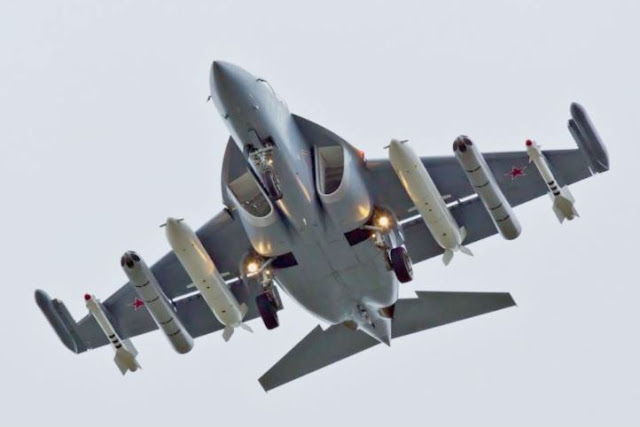
The Yak-130 can simulate the tactics of various existing fighter planes. The aircraft can carry weapons, suspended fuel tanks, surveillance pods and various electronic war pods including radar jammers and infrared countermeasures. There is one diameter of the fuselage line and the number of wing hooks for arms suspension has been increased to eight with six underwings and two wing tips, increasing the weight of combat loads to 3,000 kg.

The open architecture suite installed on the Yak-130 allows a variety of heavy weapons systems, Vikhr laser guided missiles, R-73 infrared guided air-to-air missiles (as NATO 11-Archer), Kh-25 ML (as NAT-10 AS- 10 Karen) air-to-surface laser, AIM-9L Sidewinder, Magic 2 and AGM-65 Maverick missiles. Platan's electro-optical guide pod is mounted under the fuselage for the placement of KAB-500Kr guided bombs.

This fighter training aircraft is equipped with a 30 mm GSh-301 cannon or a GSh-23 cannon mounted under the fuselage. It can also use B-8M and B-18 missiles that are not aimed, bombs 250 kg and 50 kg and cluster bombs.

Yakovlev Yak-130 Price and Orders

The price of the latest Yakovlev Yak-130 advanced jet trainer is US $ 46 Million. In March 2006, it was announced that Algeria had ordered 16 Yak-130 trainers. Deliveries were completed in 2011.

In December 2011, the Russian Ministry of Defense ordered with Irkut for the shipment of 55 Yak-130 combat trainers in 2012. The first batch of six aircraft was sent to the Russian Air Force in October 2012. The second batch of three Yak -130 was delivered in November 2012. A total of 15 aircraft were sent to the Russian Air Force in 2012.

Bangladesh ordered 16 Yak-130s in January 2014. The Russian Ministry of Defense placed orders for the supply of 12 additional aircraft in February 2014. A total of 36 Yak-130 aircraft are expected to be sent to Syria in 2016. Russia also plans to export aircraft to the Azerbaijan military.